

The (Almost Lost) Art of Silence
When I was in sixth grade, I learned about Lent and the practice of giving up something you really enjoy for 40 days. Something to do with Jesus wandering in a desert, David Elmore said. But what I was taken by was the idea of the discipline, of sacrifice. I thought hard. What would I sacrifice? My mom, Lynne, told me, shaking her head as she owned her hypocrisy, “I gave up candy, but I’d buy Smith Brothers Cough Drops, because they didn’t count.” Recognizing the trap of the generalist (“candy”), I gave up, very specifically, Doritos. (Fritos didn’t count.) Sainthood within easy grasp notwithstanding, I expanded the practice, over the years, to encompass all junk food. Can I hear a so what?
Somewhere along the Lents it did finally dawn on me that such a sacrifice was, I don’t know, lame. What is the sacrifice (Doritos? seriously?) really for, you know? Inspired by a “reading deprivation” exercise in The Artist’s Way, I realized that Lent could be an opportunity to tune out noise and make a discovery. So for Lent this year, as Miss O’ has for many other years, I gave up the distraction that is media; and in the past several years it’s been social media and sometimes also television. It really is instructive, these periods of deprivation, restful and oddly energizing.
One thing that Doritos and media have in common, by the way, is that both are engineered to be addictive. I have an addictive personality. I have to be really careful about drinking, for example, so in the past few years I’ve given that up, too, or at least drinking at home. I can drink if I’m out with people I know, which includes my bartenders at the Globe Tavern. I earned those stouts (all six over 40 days). At least I was off Facebook and Instagram, bitches.
What I get out of all this modern-day desert wandering is the happiest thing imaginable: I enjoy 40 days of a quiet mind. It’s amazing what you read, see, and consider when you aren’t scrolling a phone. This Lent gave me a surprise in the form of a different, and yet familiar quiet, a kind of memory of quiet.
Walking on the Moon
On March 22, 2023, Google made a doodle that caught my eye, and link leading to link by art gallery by video by article by book sent me down a mime rabbit hole: the miraculous Marcel Marceau, who would have turned 100 this year! I have a brief collegiate history as a mime, saw him perform live in 1986 at Virginia Tech, saw/heard him lecture the next day—mesmerizing, so brilliant. I wrote a blog about it (among other things—it’s buried in the middle) once. And here I am again.
Just full out, let me say this before I say more about Marceau: Marceau’s character, Mr. Bip, has a history, a reason for being, far deeper than easy caricatures might suggest. Marceau explains about it in a Wallenberg lecture from 2001, when he was 78 and receiving the Raoul Wallenberg Medal for the work he did during WWII as a teenager. Marceau (born Marcel Mangel) himself a Jew whose father had been deported to Auschwitz never to return, helped save dozens of orphaned Jewish children and others by leading them to the Swiss border as part of the French Resistance. Marceau’s part of the lecture begins at the 39-minute mark, and you can learn about his life from his own lips.
I want to tell you, I love mime, and I love Marcel Marceau. So let me just say that what happened to mime in the United States took his beautiful art form and made it into a parody, a travesty of silly imitation because in America we got no sense of history. Marceau’s white face, first of all, harkens back to the French Pierrot figure, and it was young Marcel’s wish to reclaim French culture after the Nazi occupation; Mr. Bip is named in honor of Pip, the protagonist of a beloved Dickens novel, Great Expectations. And it all started with seeing a Charlie Chaplin silent film with his father when little Marcel was seven years old turned the young Marcel into a mimic and the Little Tramp became his hero (but not one he merely imitated as a mature artist). Marceau was born to pantomime, he felt; it was universal, he believed—storytelling that transcended race and ethnicity and culture, found famously in the Orient and also in some form on most every continent; it was an art that could bring us together in love and humanity. Mr. Bip, his everyman, had terrible troubles, but he never lost his hope. Before every adventure, humorous and tragic, Bip removes his opera hat, smells the red flower that decorates it, sets down the hat, and tries. Bip tries and tries and tries.
Throughout the years Marceau lived his art, he taught, (and he loved to teach) at his school in Paris, what he called the grammar of mime, the techniques, and the arts that inform it, like fencing, ballet, acrobatics, and juggling. Nowhere in his teaching is there a dictum that to be a mime you must wear a white face, black and white clothes, and pretend to push against an invisible wall for no reason. Marceau wanted new artists to create new mimeodramas, new stories, new characters. He wanted his art to grow and not be mummified in museums.
Mime is the art of making the visible invisible, Marceau says. I interpret this to mean that his white face, red lips, and black eyebrows as well as his white and gray sailor costume disappear into the lights as he becomes a judge, a prosecutor, the defense, and the defendant in “The Trial.” Mime is also the art of making the invisible visible, as you are sure you are in a fully realized courtroom instead of a bare stage when you watch this same drama, or seeing a universe while witnessing the birth of the world in “The Creation of the World.” Having seen both the video and the live performance, I will tell you the live version is far more magical and transporting, but I am so grateful to have these videos to sharpen my memories. In this video of “The Cage,” Marceau expresses his hopes for what his art can do. I’m grateful for the videos, but speaking from experience, Miss O’ can tell you they can’t hold a candle to the electric experience of seeing Marceau live.
I learned in my searches that Marceau adored Michael Jackson, “a poet,” he said, who loved Chaplin (Marceau’s early hero) and Marceau, learning how to “walk against the wind” and turning it into the moonwalk. Marceau loved that. That is what an artist does—takes the old teachings and makes them new. A planet of imitators will not do. (Painters study Rembrandt and Van Gogh and Picasso, but no one would tolerate a mere mimic; there was only one Marilyn Monroe, as it should be.) And I think I felt this in my limited artist’s heart as I myself learned mime and performed. Why a white face? Because that’s what you do. Why? So I drew a line around my white face and added rosy cheeks, but it never felt authentic. Marceau would agree. I needed to find my own character for my own reasons, to tell my own stories that might be also universal. Still, I have never lost my training, still aware of how all the movements of the body articulate and what those movements can convey emotionally. I still love the art, this art of silence which is really so much more.

So imagine my joy as a result of the click on the Google doodle to find out 1) NYC has a National Arts Club on Gramercy Park South, which is free; and 2) said space has an exhibition of Marceau portraits by photographer Ben Martin. And imagine my joy at finding out the book is back in print, and that on Thriftbooks I could find two other books by Marceau, including one with his own paintings and one co-authored by a man I actually know, all on the art of mime. To learn more about tis wonderful artist, there is a 2022 documentary that Miss O’ dreams will come to New York City.
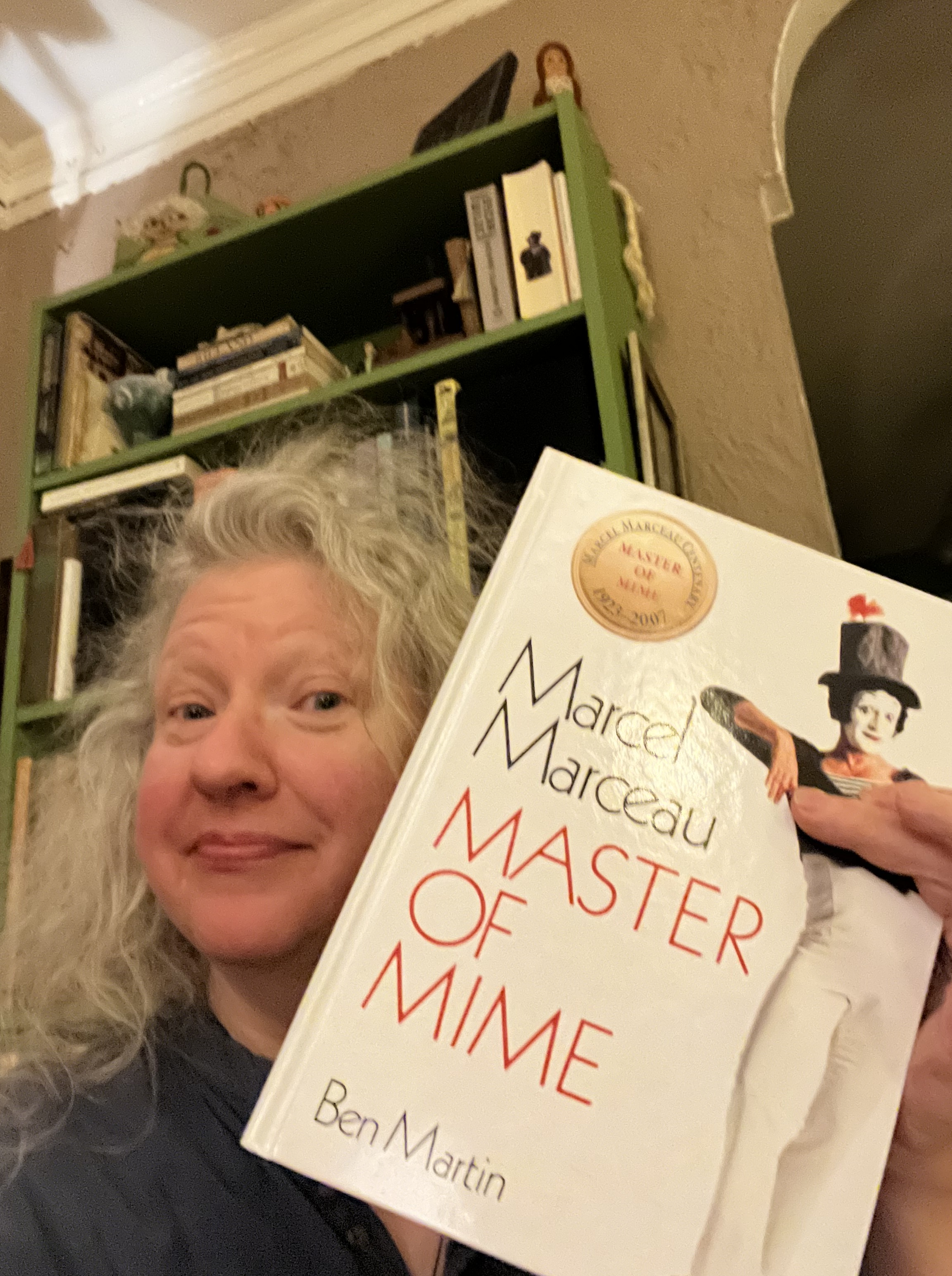


“One must think like a hero to behave like a merely decent human being.”
~ May Sarton, Journal of a Solitude, 1973
Bip is the hero of his own story, and in moving through the world heroically, he is a decent creature and shares with us his decency. (Miss O’ notes here that feeling oneself to be a hero is not the same as feeling oneself to be God. Gods are monsters. Take a memo.)

Photo by LO’H, National Arts Club, NYC
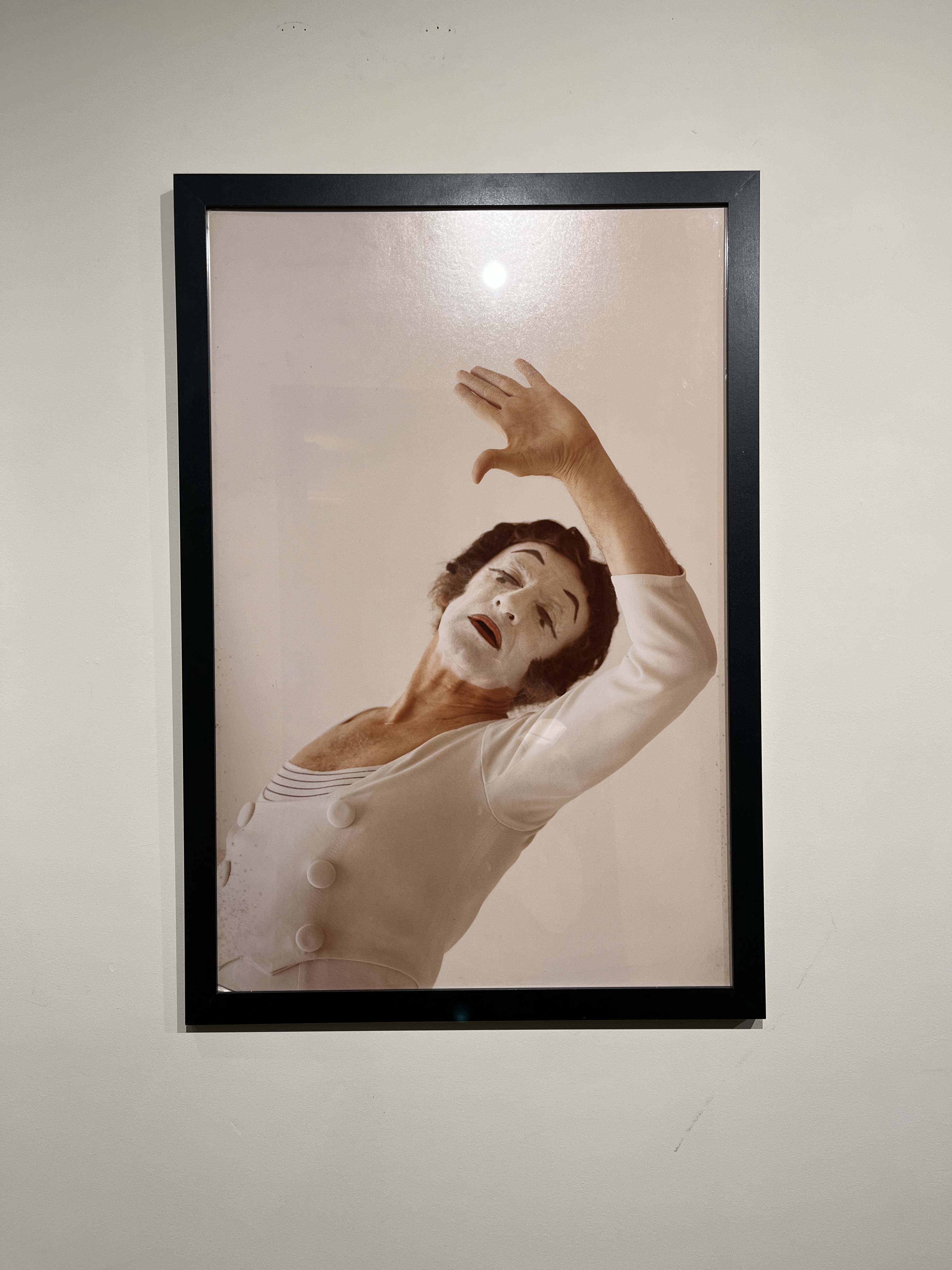
He was wrong. Photo by LO’H, National Arts Club, NYC
On Being, in Mimicry
I realize something every time I latch obsessively onto a form of study, such as mime, I begin to see reflections of that obsession in everything; in this case during Lent, mime was suddenly everywhere. The art of mime, of mimicry for survival, is in fact all around us, and I lucked into specific connections (well, we luck into things when we are looking, don’t you think?). Listening to the podcast On Being recently, I heard about the work of Janine Benyus for the first time. She helps companies learn to use the tools of nature, the natural processes of successful living things, to solve their manmade engineering and environmental problems. Isn’t that fascinating? She herself never understood why it wasn’t simply obvious to follow nature’s lead. Since childhood, Benyus had loved wild spaces, and was traumatized the first time she saw bulldozers destroy her wild lots, where she knew all the creatures and plants by their names and habits. I myself grew up catty corner from a huge vacant (we say “vacant” when there are no humans living there, you notice that?) lot that was anything but empty: filled with a creek, rocks, a dirt lot for kickball, pine trees, grasses, and blackberry thickets. When I was in my 20s, a developer bought the lot and turned it into houses, cemented up the creek bed and fenced it off with high chainlink—it was horrifying. And that sadness made me remember the old McNeil sisters who used to pick those blackberries—all that land had been once their father’s farm, and now they shared a house on Kentucky Avenue in a huge subdivision. And that made me remember that before that, it was Native American land. And before that, a wild place for all the creatures. This endless cycle of taking over, of colonizing, is really painful when you tune into it, in ways small and large. (Marcel Mangel grew up in Strasbourg, in Alsace-Lorraine, which was sometimes German, sometimes French, in the struggles to own territory, to annex, to conquer, and we all know what that led to.)
In her book Biomimicry (on my booklist now) Benyus explores how humans have ignored the ways in which nature can teach us, that because humans see themselves as having “dominion” over the earth, we think we have to do all the thinking. And our thinking is often sheer stupidity; and that stupidity is killing the planet. Benyus talks about this without malice, with love and hope, though. Podcast host Krista Tippett read aloud from the last page of the book, showing there is hope for solving the problems we have created for our world:
“The good news is that we’ll have plenty of help. We are surrounded by geniuses. They are everywhere with us breathing the same air, drinking the same round river of water, moving on limbs built from the same blood and bone. Learning from them will take only stillness on our part, a quieting of the voices of our own cleverness. Into this quiet will come a cacophony of earthly sounds, a symphony of good sense.”
~ Jane Benyus, Biomimicry
I thought of Benyus’s continued hope this stillness, and it put me in mind again of Marceau, of Bip. In the quiet of his performances, Marceau elicited a cacophony of earthly sounds, perhaps in musical accompaniment, by Bach, say, but always also the laughter, gasps, and applause of human beings. Marceau played at life, at dreams in the hope a symphony of good sense, but more than that, a symphony of love.
From Benyus’s trauma of seeing her wild space bulldozed through past the topsoil to Marcel Mangel’s witness to Nazi persecution down to his own father’s deportation and murder—both made art out of it, science out of it, education out of it. Their work is and was marginal, and made more important and beautiful and necessary because of that. We all do our best thinking doodling on the margins, don’t we?
Vanity of Vanities, All Is Vanity
“The whole point of Jesus’s life was not that we should become exactly like him, but that we should become ourselves in the same way he became himself. Jesus was not the great exception but the great example.”
– Carl Jung
On Easter Sunday, people post, “He is Risen,” that sort of thing. When people fall into idolatry, worship, they may also slip into an inauthentic imitation, or a glory of themselves in the religion rather than the religion in themselves.
I don’t understand worship. I understand curiosity and passion, and I understand a desire to learn. We lose great art, great thought, great science, it seems to me, when we see imitation all around us. Education, enlightenment, and exposure to new ideas are supposed to help us become who we are, generate more new ideas, new hopes and dreams, new beauty.
I think mime died out (which is not to say it’s dead) for two reasons: 1) it’s unbelievably hard to do well; and 2) everyone tried to be Marceau. This is a shame. Marcel Marceau wanted to teach people mime because he loved his art, not because he wanted a planet covered in white-faced pale imitations of himself. He loved Michael Jackson because Jackson (white-faced and pale though he became) took a lesson in walking against the wind and turned it into the moonwalk; Jackson elevated the form and made it personal. Similarly, Jesus didn’t ask for a planet full of imitators and power mongers to “spread his word” (his apostles did that); he (lowercase human pronoun) wanted people (as I read it) to simply live in a radically alternative way: love over hate, kindness over violence, the love of all over the love of money, equity for all (women, men, whatever) over huge power of some over the rest. It’s not difficult. But it feels impossible to accomplish, like walking against the wind.
The nature all around us, the earth that holds us—how does this not feel like our true mother, our closest companion, our guide, our lover, our teacher, our friend? Why do we push it off, push against it and each other?
Let us, like Bip, don our opera hat proudly every day, dressed up with a fresh flower on top, the scent of which we smell with delight before we move to walk against the wind into the world to do the best we can.
Silence is about attention. An audience may break that silence with response. Something inward goes outward. I say that because most everyone now can be seen staring silently into a phone, scrolling dead-eyed, a quiet trance of habit that isn’t what I mean by silence at all. With Marceau’s art, silence is about concentration, the mime’s attention to the art in emotion, and the audience’s attention to the performance. If we mimic anything in this life, let it be the nature around us, and the artist’s attention to his art. And another’s kindness.
Love, somehow, to all.













 The Miss O' Show (Teacher's Edition)