“Blogs are a conversation no one wanted to have with you.” – Michelle Wolf
Making an Effort
On Sunday morning I went to the Grand Bazaar flea market on Columbus Avenue in Manhattan. It was a lovely, soft day after a rainy Saturday. Three years out from the start of the pandemic, New York City has been slow to come back. Even before the lockdown, I’d noticed a steady and sad decline in “caring” when it came to personal appearance. People looked dirty, soiled, tired. Pajama pants and slippers in public became “fashion.” Was it poverty? Apathy? Depression? I don’t ride into the city (as we say from Queens, an outer borough) much anymore, since I can work from home more easily, but when I have taken the ride, it’s been a disappointing view of humanity, let me tell you.
Sunday was different. Sunday, I couldn’t help noticing, was awash in color and pattern, sartorial surprise, period fashion statements. An avid follower of the late Bill Cunningham, I have come to understand how street fashion tells us things about ourselves and our world that nothing else can; it is a true barometer of the local or (in the case of New York) (inter)national psychic weather.
Two Christmases ago, for example, Justin Vivian Bond and Kenny Mellman returned to open the Brooklyn Academy of Music (BAM) for the first time since Covid, and Mx. Viv sent an email announcing “Kiki and Herb Sleigh Christmas” in which they beseeched ticket holders, “Make an effort!” It was a plea to look nice for a first big night out, for an occasion, to cheer us all up. I found my silver jacket and silver jewelry and duly duded up. Sadly, I was one of the only people in the entire place who not only made an effort but was what my mom, Lynne, would call appropriately dressed. My dear companion wore torn jeans, sneakers, and a bubble jacket. This was the general audience trend. Similarly, when the Metropolitan Museum finally reopened the previous August, I made a point of dressing in a smashing casual but coordinated ensemble; my companion that time wore clothes that appeared to be pulled from a dumpster—torn, ill-fitting, sad, unclean. He fit right in.
And all a person can do at that point is take the information as it is given to you: here is poverty (financial, emotional spiritual); here is a sad person; here are sad people; here are disconnected people. I don’t think this is about me being Judgy McJudger—it’s about reading the national room. And dear god what a depressing fucking room.
So this Sunday in May of 2023 was a revelation, and I wish I’d brazenly taken photographs: the adorable young woman in red Chanel hat, vintage red mini skirt and jacket, white ruffle neck blouse, red patent leather shoes, white stockings; the smart looking middle aged woman in 19th century dark blue hat and coat, who when I complimented her said, “This is my normal,” to which I said, “I love your normal.” Color and line and surprise abounded on Columbus Avenue.
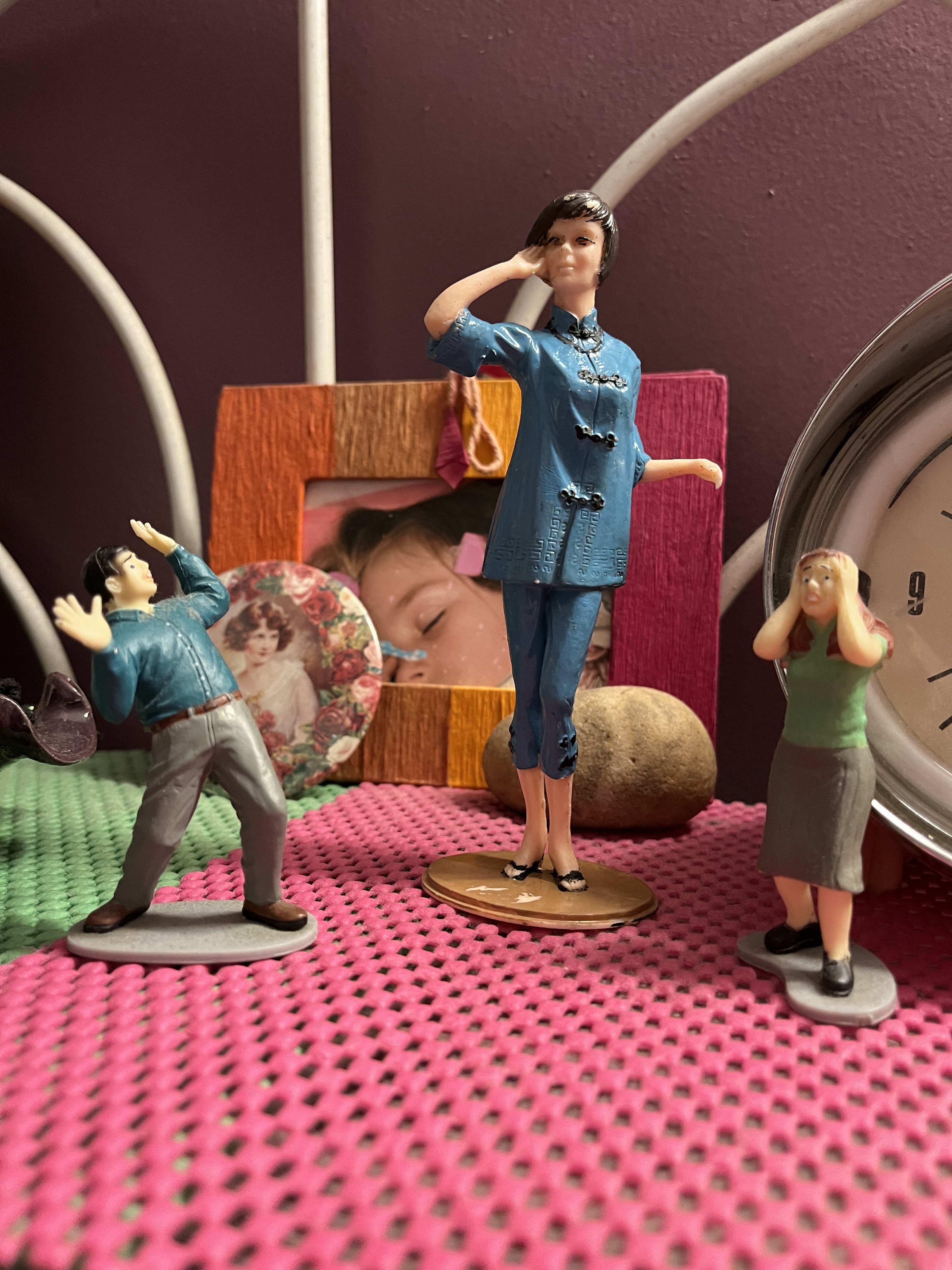
$15 Flea find: 10 cent figurine, ca. 1964, completes the bathroom narrative.
Also on display: kindness. People’s nice attitudes mirrored their nice style. I sat on a bench outside the market with a woman named Jenny, her dark hair, very straight, pulled up by a bobby pin; she had a huge sack of apples for her three parakeets, too much weight to carry considering she’d had a hernia operation two weeks ago and uses a cane, what was she thinking; she was waiting for her Access-a-Ride to take her back to the Bronx. When she got the text, I carried her bag for her down to the waiting van, glad to do it, nice to meet you. Back to the bench, I found my friend Ryan just arriving. After a long conversation, a light lunch outside, and a market spin involving Turkish pillow shams, he said, “I need pickles,” and we sauntered over to the pickle vendor. A quart of half sours for him, a pint of kosher dills for me, the filling of the containers looked “like Tetras,” Ryan said, and the weary vendor half smiled.
As I stood there in the afternoon sun, I felt a tap on my shoulder. I turned to see a tender young woman’s face, fair skin and full rosy cheeks, kind eyes, and she said, “I just had to tell you how beautiful you are.” I must have looked confused. “I saw you from over there,” she said, “your hair, your bag, just all of it. I needed to tell you.” Tears welled up in my eyes, and I laughed. “I needed to hear it!” I said. I thanked her. Ryan laughed.
Breaking Patterns
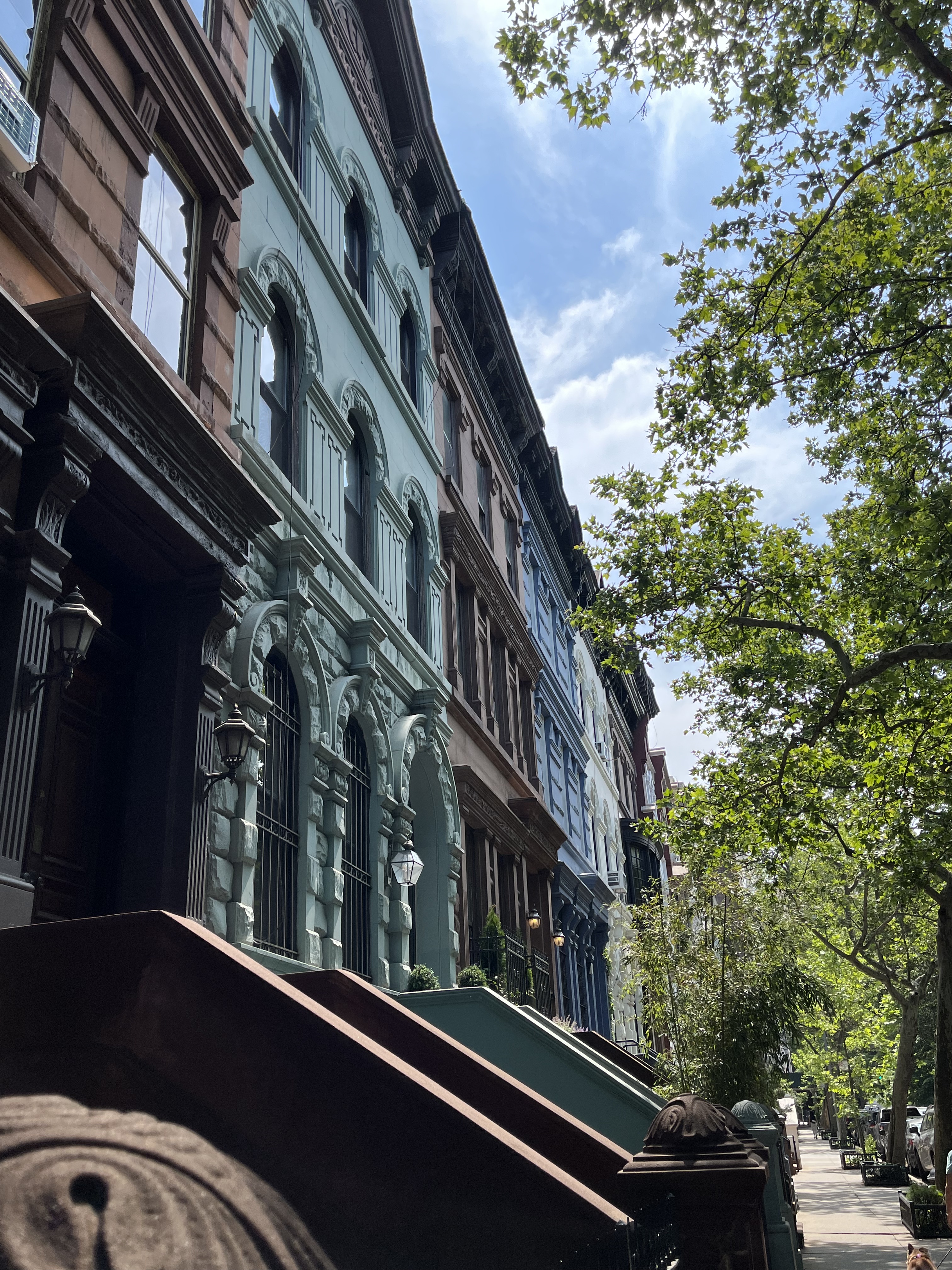
Upper West Side row houses. NYC
Against my better judgment—because I knew what would happen—I found myself relaying this joyful little anecdote to a couple of friends I happened to chat with later, and truly, the moment came up organically out of each conversation, talking of kindness. By sharing it, I meant, “It’s so sweet to hear kindness like that,” or “New York can surprise you sometimes,” but that isn’t what they heard. And what happened instead was just what nearly always happens when I share these rare sweet moments. The first friend quickly changed the subject. The second friend said, “Well, it must have been because of your confidence, or the way you carry yourself.” Because obviously, was their message, the woman lied to you.
I celebrate a time when we can have more expansive ideas of what beauty is. We’ve had impossible standards for so long, haven’t we, all to do with youth and god-given physical features? And yet there I was, Miss O’, gray-hair up in a bun, face wrinkled, belly fat, my silhouette double-chinned and pale, standing simply in black chinos, a pale olive linen shirt, comfortable shoes, carrying an Indian print bag and waiting for pickles, and this dear child was clearly struck by beauty, somehow.
And the first impulse in others—because this is America after all—is almost exclusively to snatch away your bit of joy, the sweet moment, and remind you that you are old, ugly, nothing to look at, how could you be so foolish as to take in a kind word? Why even wear earrings, a necklace, a scarf? Why did you bother to make an effort? Who do you think you are, little missy?
And my whole point today is really this: When we try, when we choose what we wear with a thought to personal (not to say expensive) taste, with care, with attention, and with our hearts, and we put this out into the world with some effort at kindness and connection, we just might make someone else really happy. It’s not always about me, or about you. It’s about them—the people who have to look at us. They might be having a sort of nothing day and your presence, that effort you made, could make it a little nicer.
What’s wrong with that?
I’ll tell you what’s wrong with that: Not a goddamned thing.
Love to all. Somehow.
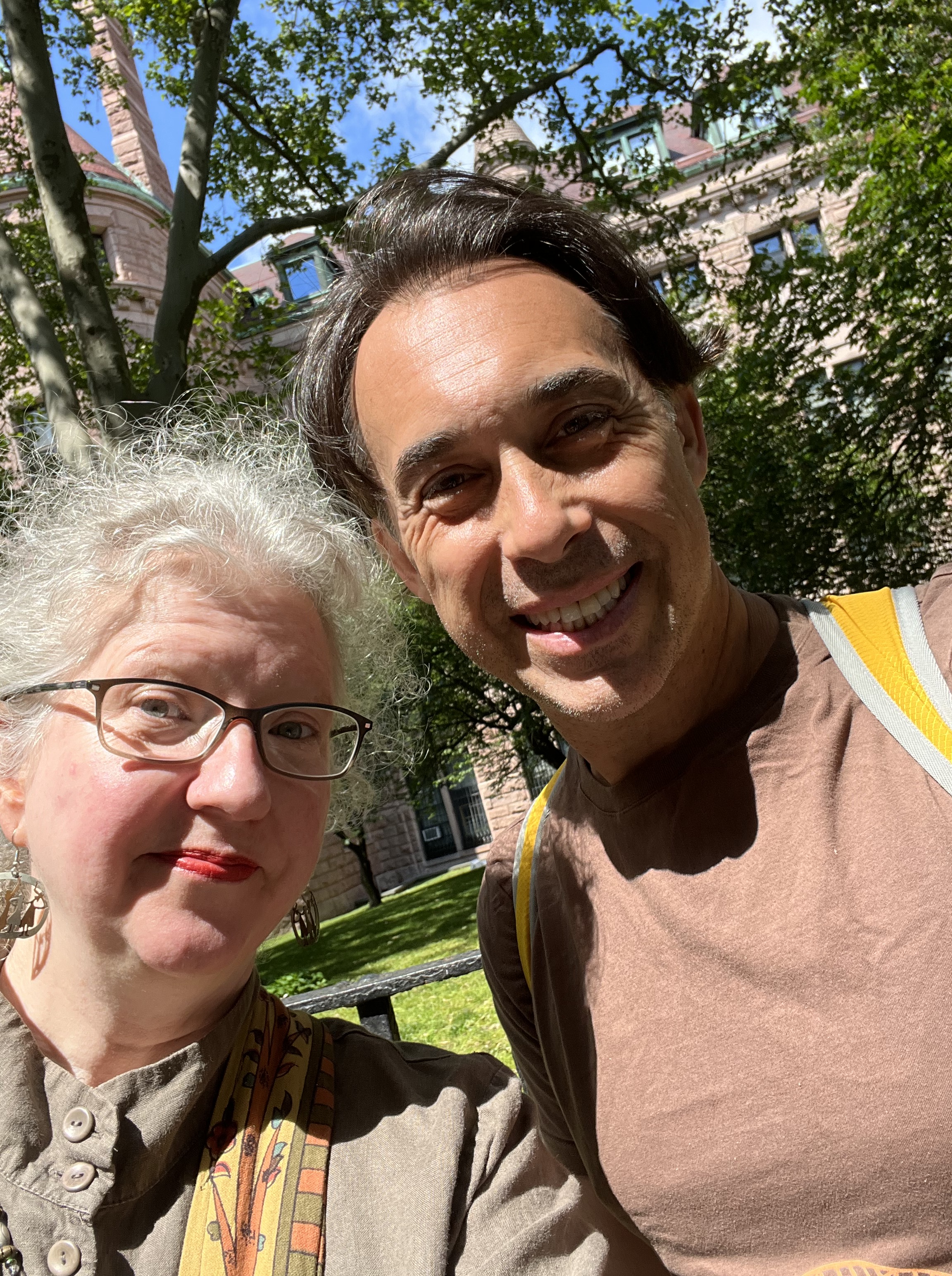
Two beauties: Miss O’ and actor Ryan Duncan, Manhattan
Did you ever have one of those days (years, lives) when everything breaks? The one where you look at the pot handle lonely in your hand as the pot you wanted to fill with water clangs onto the kitchen floor, and you scream, “I’m so glad this is hard.” Dumb tasks that should take a second become all-day quests on the scale of Don Quixote. The other morning one of the little plastic doohickeys on the collapsible plastic tube that keeps the toilet paper attached to the porcelain thingy on the wall snapped off when I tried to replace the roll. My first instinct in cases like this is to try and fix it. So several squirts of epoxy and some duct tape later I realize, “For the love of god, Lisa, stick this in your bag and go to a hardware store.” $2.99 + tax later, all was mended. But the cost to my day? Priceless.
Everything, it seems to me lately, is breaking. The existential stuff, sure, but what about my parents’ yard? The other week when I visited Virginia, brother Jeff and I pulled into our parents’ driveway, and the first thing I noticed was all the chickweed in the flower beds. By this time of year, those beds are cleaned out, mulched, and planted with petunias, but ol’ Bernie in his 89th year has a hernia and was waiting for surgery, so all the planted beauty was on hold. Upon surveying the rest of “estate,” I noticed piles of oak tree spooj, er, “catkins,” in pond form on the driveway and pea gravel patio; periwinkle out of control; a dead dogwood. So after days of rain, during which I cleaned their house, stocked up at the grocery store, and did whatever other daughter stuff was needed, I set off for outside to pull chickweed and sweep up the driveway.
Within ten minutes of using the outside broom—mended at the bristle-handle connection several times over with Gorilla (TM) tape—it broke past repair. The handle coating was cracking in strips. The third time I used the dustpan it literally crumbled in my grasp.
WHAT IS HAPPENING?
I just turned 59, so you’d think I’d just roll with all this, but in truth I got weepy, not because of the broom and dustpan, though sure, it was an inconvenience (I texted Jeff to please buy one at Lowe’s while he was there picking up a new latch for the 50-year-old front storm door, the one that caused our father to get locked out the previous morning while out getting the paper at 4:30 AM—fortunately we are all early risers and I heard the knocking while Jeff was in the bathroom and our mother still in bed with her coffee). It’s that all this infrastructure breaking down mirrors my parents’ physical and mental deterioration; inevitable though it is, and tough old birds that they are, it’s not something you can just smile through. Though we do, often as not.
Couple this personal existential stuff with the coming end of the democratic experiment in America—and forget that, what about the EARTH?—and I have to ask, how are we all not losing our minds?
Blooms Buried
This spring, everything bloomed a full month early. (New York City—a city of subzero winters and months-long snowpack when I moved here 20 years ago, had the warmest winter I can remember, and sadly will probably never know such cold winters again in my lifetime; my co-op doesn’t even bother to order salt anymore, and we used to order a dozen bags a winter.) I do not celebrate this. Lilacs, a mid-May flower, were here and gone in early April; so were the daffodils, tulips, and azaleas (a late May bloom), all at once. I don’t know if you follow bloom schedules, or enjoy the unfolding of seasonal changes as I do, but last spring’s walks were simply miraculous, helping me emerge out of my Covid coma, spring taking its sweet time moving from crocuses, to daffodils, to tulips, to blossoming trees, to irises, right up to honeysuckle.
This year, it’s like the whole bloom gang showed up drunk to your spring party and passed out as they handed you their coat.
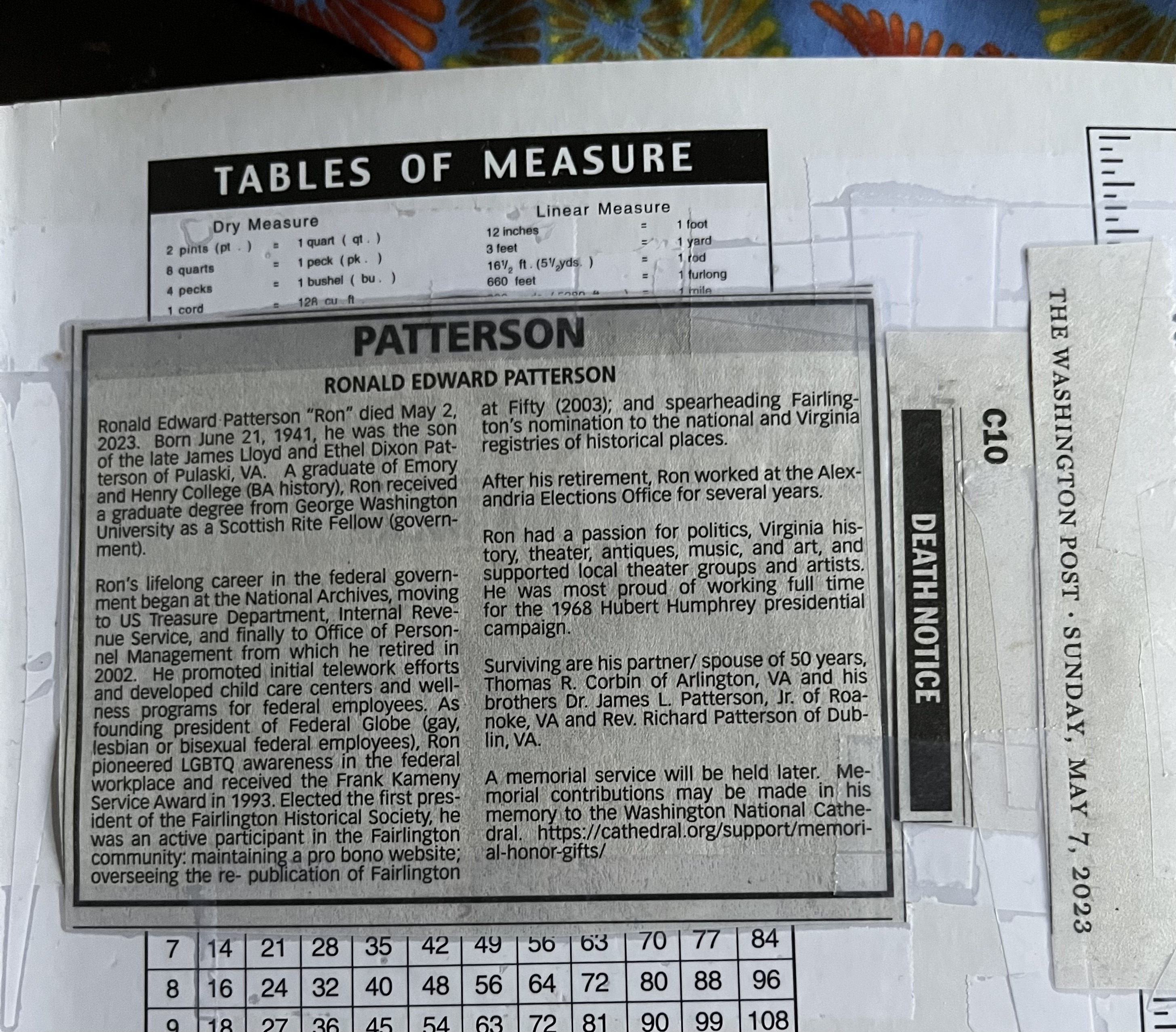
My friend Tom, a Virginia native, retired English teacher (mine, in high school), and avid gardener, called me from his Arlington home a week or so before my visit, freaking out about this seasonal disruption. “What is happening? Everything bloomed for a split second and was gone! I can’t keep up!” He was also freaking out because of the steady and unstoppable decline of his partner and spouse of fifty years, Ron, who was dying of cancer of the bile duct in a nearby nursing home. And as passionate about politics as he is about poetry, Tom was also having apoplexy over the Republican Party’s transparent policies to unapologetically end democracy. Death was in his garden, in his home, in his country. It was all just too much to handle all at once, and yet there he was, handling it.
Before I could visit, Ron died shortly after I arrived in Virginia, peacefully but still unexpectedly around noon on May 2, right there with Tom. It happened the day after the 50th anniversary of their meeting. EMTs, police, inquest, courthouse, death certificate, phone calls to insurance and Medicare and Social Security and Dominion Power and the bank…and not a second to grieve. Our whole American system is hurry-up heartless. Tom only spoke to one actual human, who was so kind, while the rest was AI simulation voices or operators from overseas reading from a script of “How can I help you today?” to “I am sorry I could not fulfill your request.” Fuck them all.
Tom’s obituary for his partner and spouse of 50 years, in my journal. How do you measure a man’s life?
Today is Mother’s Day, and so far Lynne is hanging in there. On Thursday, May 18, the good lord willing and the creek don’t rise, my parents will celebrate their 60th wedding anniversary. On June 5, my dad is scheduled for outpatient hernia surgery. Meanwhile Jeff is cutting the grass and trimming out the lawn; we bought a hanging basket for the backyard while I was home. And Tom is trying to figure out a good time to have a gathering to remember Ron, at their home, maybe this June; and Democrats still use their elected offices for governance of and for the People, bless ’em.
Miss O’ and mom Lynne, May 2023Miss O’ and brother Jeff O’, train station, VirginiaBernie and Lynne with their oldest child and youngest grandchild (not Miss O’s)
Our Earth continues to warm at a beyond alarming rate. Republicans are breaking democracy. Declines happen. But the death of the Earth, the death of democracy, unlike human death, is not inevitable. We don’t have to lose them. We don’t have to annihilate all life as we know it just because a few people are having, I guess, really bad days (years, lives) and are taking it out on all of us.
This week I sent money to Biden to stop fascism and Brady to stop guns. At the farmer’s market on Saturday, I bought plants for the porch pots on my little deck over the trash alley here in Queens. Every little bloom counts. It has to.
“I used to teach just the way I was taught, but now I let someone else do all the work for me. If plants are our oldest teachers, why not let them teach?”
~ Robin Wall Kimmerer, Braiding Sweetgrass: Indigenous Wisdom, Scientific Knowledge, and the Teachings of Plants
I lived in the country for the first twenty years of my adult life, and I have country trees I could talk about, but events of the week got me thinking about two particular trees—of my childhood and now—so much so that I had to try to draw them. I thought I’d tell you about them, though I’m not sure why I need to do this. Let me know if you figure it out.
Suburban Trees
When I was 11 or 12, I think, my next-door neighbors, Mike and Diana, hired people to come and chop down a weeping willow tree on their property, a tree that had grown to be nearly as large as the house itself. The willow sapling was planted around 1965 in the front yard by the first owners, John and Barbara, who moved to another subdivision around 1970 and who hadn’t really understood that a weeping willow might not belong in a front yard. The weeping willow is a tree I used to see in backyards in the Midwest, often along small creeks. It’s really not a front yard tree. Anyone could see the truth of that, since no one could any longer see the house from the street.
Sitting on my bed beside a window that looked over to their yard, a view nearly blocked by a giant cedar (one of two that framed our house, and which would be cut down and hauled away when I was in my thirties), I sobbed. I’d been standing in the yard when I saw what was happening, and began to protest, wanted to scream, and my mother said, “Oh for heaven’s sake, Lisa, it’s a tree. It’s too big. Get over it.” Something like that. She wasn’t wrong. Still, I ran inside and upstairs to my little room and slammed the door. Even as I type this, I can smell the old paint around my window, the glazing, a metallic dust smell, and feel the texture where my fingers gripped the sill. My runny nose against the chill of the glass, I had to turn away. I couldn’t watch. Still, I sat holding all my concentration on the tree during the chopping process. I felt I owed it to my friend.
How do you explain being in love with a tree? I was in love with many trees in my own yard, sure, but that was puppy love compared to my feelings for the willow. I used to float underneath it, back when the Yanos lived in the house; swim as one might in the sea, though I’d never been to the sea. I remember that I spent most of my time under that tall grass skirt on “my” side, closer to my house, not all around it, like there was an invisible wall that prevented me from complete freedom inside the arch of branches that reached to the ground. But I remember the magic, how deeply scared and amazed I used to feel. I don’t know why. So cutting down that tree was like watching a friend being murdered, everyone telling you it’s just a life. Get over it? How?
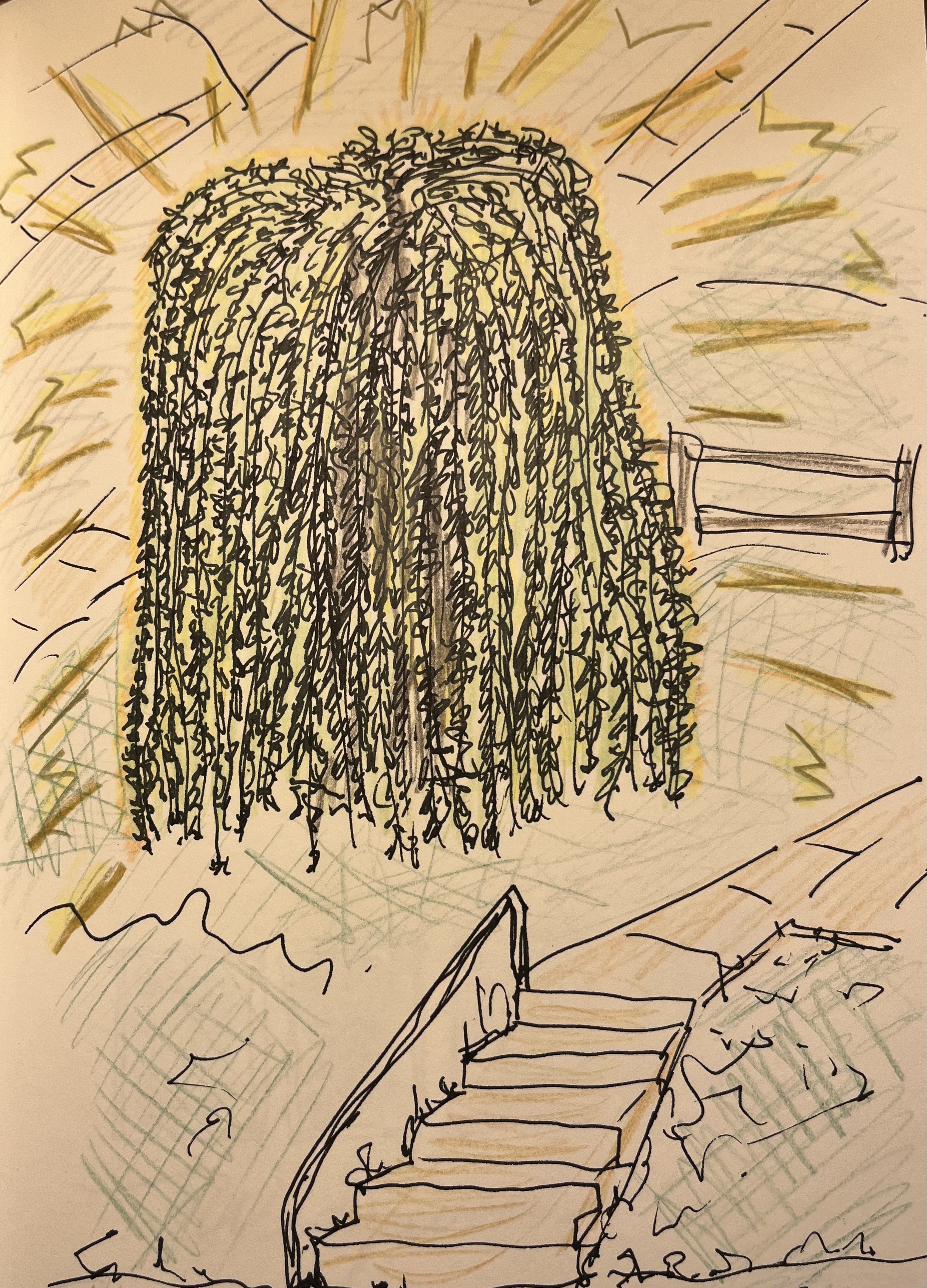
Weeping Willow ca. 1976 by LO’H
There were certain trees, growing up, that I felt belonged to me. I was so lucky to have, and my parents worked so hard to buy, a home, one with a backyard, in a subdivision whose designer left big swaths of old-growth trees across backyards that abutted across two streets, over blocks. Different kinds of oaks in my own backyard are still there, and I visit them whenever I go back to Virginia (touch wood) to see Bernie and Lynne, now in their 89th years. There’s the holly tree by the horseshoe pit. And I still “see” a beech tree that is gone now. I loved climbing it—not very high. I regret that I never really got to know the cedars. I don’t know why, exactly, but I suspect it’s because they were planted for ornamental reasons, and not quite part of the forest that was as much my home as anything inside. And unlike the willow, the Flahertys’ monstrously huge crabapple tree that the Hunnicutts planted across the street survived (Mrs. F. loved the spring blossoms) for years longer; though the next owners, whom I’ve never met, finally had it chopped down, at least I had that tree all through my childhood. And the forest that was my backyard home.
It’s even more magical now. Bernie and Lynne hauled every rock.
City Trees
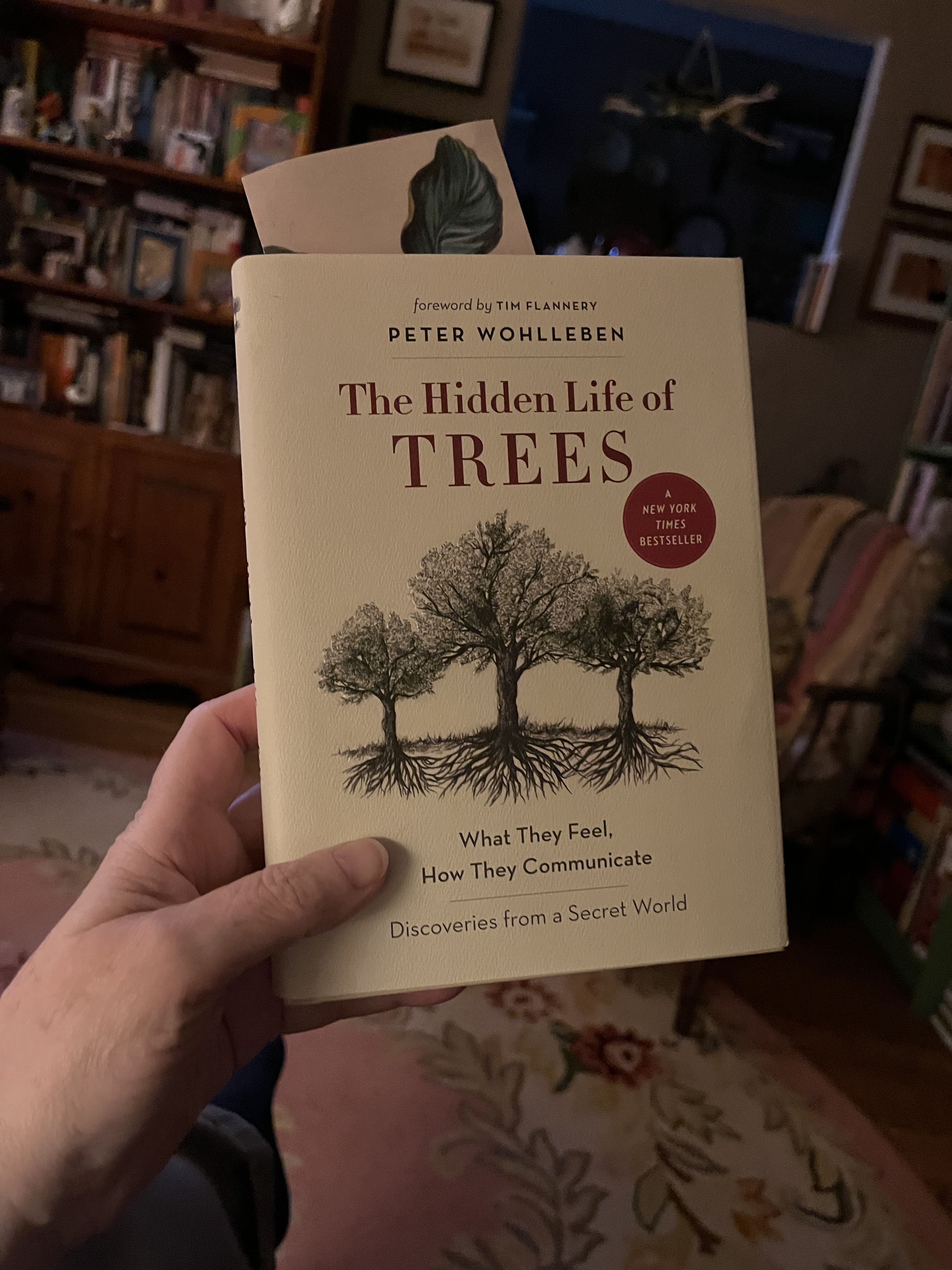
Several years ago now I was out in California visiting friends Anna and Michael, and one of the books in their guest room/office (pro tip: please have a library in any room where you have your guests sleep) was The Hidden Life of Trees: What They Feel, How They Communicate: Discoveries from a Secret World by Peter Wohllenben, a German forester. I recommend it.
“Trees can grow in many extreme environments. Can? Indeed, they must!”
~ The Hidden Life of Trees, “Specialists”
The upshot: Trees feel, they know, the connect, they have real lives. Any kid who has loved a tree the way I loved that willow could have told you that, but it’s better to have science to really drive it home, I guess. All of this is just to say the lost trees of my childhood aren’t the only ones I’ve grieved, and the older I get the more deeply I know there are connective threads among all these living things that only my heart understands. And it matters.
In my co-op apartment building in Queens, to take one example, the board has long neglected one side of the complex, the side I enter on, because no one else really sees it, as they enter on another street. A giant mulberry tree (that no one missed) had to be taken out of the fenced “garden” about fifteen years ago, before it compromised the foundation, though the seedlings and shoots keep coming up out of old the roots. (The struggle is constant and will be until we can afford a landscaper to dig it up properly, but you have to admire the tenacity, you know?) But it’s this one other little oddball tree, a blue spruce, on the edge of the iron fence that meant something. With the mulberry gone, it really took off, so I had to trim it a lot to keep the prickly branches from hitting people as they walked past. I did not trim it well, but I did the best I could. It looked like a giant bonsai tree. Okay? But it was our giant bonsai.
Last year, a neighbor in the complex thought he was giving me this great gift by chopping down that one remaining tree, that badly trimmed blue spruce that, it turns out, a few other folks in the neighborhood had also secretly called “the bonsai spruce.” I returned from a weekend visiting friends to see it gone, and I felt I had been punched in the chest. I choked back tears until I could get inside. I’d read an email from this (really very nice) neighbor which said he had “cleaned up the garden” but without mentioning this act of, frankly, vandalism (apparently he’d only cleaned up the garden because he personally hated that tree). People who regularly walk their dogs still ask me why we got rid of it. It’s sweet, though, isn’t it? I was amazed by how much of a touchstone that crazy little misshapen tree was for the residents of a Queens neighborhood. And you think New Yorkers don’t have hearts.
Illustration by LO’H
More City Trees
This past weekend I and two neighbors from the complex worked to remove an invasive tree near a cedar on the other side of my stoop, the smaller iron-fenced garden area along the sidewalk. Travis and Vaughn had taken a tree-pruning class when they lived in Brooklyn (!) and had the tools to properly prune a remaining tree (that someday really has to be removed) so the branches didn’t compromise our porch overhang and a couple of windows (should a big windstorm hit). They also trimmed the tall cedar (one we want to keep) way back away from the brick on one side and the sidewalk on the other. The city has been on everyone’s case to clear out anything remotely embowered in order to deter rats, so all this stuff had to go. (And now with all that low growth gone, maybe that weird old man with the red cart will stop pissing on the cedar as he pauses on his walks—at least I hope so.)
My upstairs neighbor, Debbie, who shares my entrance, came down to investigate after we’d finished up. Earlier in the week, Debbie had discovered a dead squirrel in full rigor sprawled out flat on the sidewalk. She texted me—I work from home and was on a Zoom call, but I couldn’t ignore her sad face emoji and “Our squirrel friend is dead.” This little guy has been around for years, digging in my herb pots and frolicking in the trees we’d just trimmed back. But I’d leave water out for him and the sparrows, in a plate on my little kitchen porch over the trash alley; once I left him a plum, which he took. The couple behind me also feeds him—he does get gaunt if we don’t help. The dead squirrel seemed bigger to me, but maybe it was the dead bloat thing. Because the kids were about to get out of school, we couldn’t just leave him there on the sidewalk. “Debbie,” I said, “can you get your snow shovel and sort of scoop him into the garden?” Good idea, she said. I went back to my meetings. A couple of hours later, I texted her and she came downstairs. We looked at his body there, exposed on top of weeds, and we couldn’t leave him like that. I remembered I had a real dirt shovel, left over from the old farm days, and I brought it up from the basement, dug a hole in our shitty old garden (or “garden”), into which hole Debbie scooped that stiff squirrel body. I covered him up with dirt, we said a few words (a shocked little boy saw what was happening as he walked with his dad; “You weren’t supposed to see that,” I said, and Debbie said, “He passed away, it was his time”). Ceremonies matter.
But while Travis and Vaughn and I were trimming on Sunday, Travis noticed there was a (live) squirrel watching our proceedings from all the way over at the other edge of the building. When Debbie came out later to check out our work, I saw that little squirrel again, but this time along the railing by the cedar. I’d noticed a huge nest in the cedar tree but thought it might belong to a family of house sparrows, so little do I know of nests. Debbie said, “He’s a friendly guy, isn’t he?” And then it hit me: That is his nest! This is our squirrel! He was still alive, after all. But man, had we fucked him over.
Illustration of existential moment by LO’H
I thought, suddenly, that maybe Vaughn had cut out the nest, but he hadn’t—there it was, up near the top. But it’s like if the back side of your condo was blown out, and you still had to sleep there. And I grieved that we’d ever trimmed that cedar. Trees are life, and how we measure all of nature in terms of human (in)convenience is really a testament to our planetary tragedy, isn’t it?
So let’s take a page or two out of Braiding Sweetgrass and The Hidden Life of Trees. Life is love, loss, grief. And nature. It’s all nature. Even in New York City.
Miss O’s childhood sidewalk, summers ca. 1960s to ’70s (skates, bike, and bare feet not pictured)
New York City, like most of the planet, has been enveloped in a heat wave for the past couple of weeks. Until around 4:30 this morning, at 82 degrees and 68% humidity, I’d managed to avoid turning on my air conditioning (I know this sounds pompous, but fuck it: I figure it’s the least I can do for the earth). But yesterday, walking to and from the farmer’s market, I heard or saw a half dozen ambulances, and not counting Covid or other catastrophes the only other times you experience that here are during heat waves—heat stroke victims who live on the eighth floor, say, and can’t afford to own or run an air conditioner (55%-70% of our incomes are spent on rent here). Friday evening I was pulling garbage to put out for my co-op apartment complex (only 17 units, could be worse with a super on vacation), and even with help and being fully hydrated I had to stop to get more water, rest, breathe. And I had to wear a mask for the smell, and latex gloves (that became filled with sweat), so that didn’t help. The air quality is bad, too. Oil, engines, machines. I awoke in wee hours today, as I say, hearing my 88-year-old mother’s words on the phone yesterday, “Don’t die,” and broke my vow. Sure, I’ll live another day in the mid to upper 90s, but to what end?
In the trash room, Miss O’ fights with the bad recycling.
Calm My Ass
Scrolling through the ol’ Instagram at 5 AM as I drank ice water and waited for the cool air to kick in, I came across an ad for a popular meditation app. There are three signs, it flashed up in meaningful words, that I might be “emotionally detached”:
Neglecting your needs or depriving yourself of pleasures [Warning: lack of parallelism coming up. -ed.]
You are numbing yourself with social media, food, or alcohol
You feel inadequate and alone
So…Tuesday? Because isn’t this everyone on the planet who is guided by love, at this point? (Note: All kinds of five-star ratings and quotations came up, too, encouraging me to “face my fears” and “become a new person”…by, what, shutting off?) I mean, did you watch the eighth Jan. 6 hearing? I think Rep. Elaine Luria (D-VA) summed up the week’s news well with this tweet:
Take a lesson, people.
This app ad got me realizing that in fact I don’t want to be peaceful. Far from it. I want a fire in my belly. I want to feel engaged, alert, excited. I’m tired of feeling tired, sick, inert. This world is on fire. I want to make the dogs bark.
Angela Sidney, Life Lived Like a Story, 1990, p. 156University of Nebraska Press, 1990. These women are true warriors.
The Voice
Question from a friend and blog reader: “All your blogs have a very specific rhythm and pattern. Is that intentional?”
Answer: Yes. [Shakes head.] (Also, No. [Nods.])
I also responded, “I’m not sure it’s pleasing. I play with moments.”
I think a voice one “hears” in a letter or blog (which for me is a kind of letter) is as particular as a speaking voice. I think there is an expectation with writing that writers will mix it up a little. Certainly, in my speaking voice, I can become a little bit Southern (from my Virginia background), or a little Midwestern (my folks), or randomly Cockney (natural mimic), depending on my mood and who I’m with. But really, Lisa O’ has one speaking voice. And over time, I’ve developed one writing voice, and I find it only varies when I am writing, say, dialogue for characters. I think it’s okay. (I knew a wonderful professor, Andrea Lunsford, at Bread Loaf who introduced herself at seminars by saying, “As my granny used to say, ‘Andrea, you have a loud but by no means pleasing voice.'”) I mean, you always know it’s a Keith Haring work, or a Georgia O’Keeffe painting, no signature required. And I don’t think you have to be that level of genius to have your own style and say many things within it.
A few years ago, a friend’s son (and he’s my friend, too) and his boyfriend at the time visited my home in Queens. He later told me that I had a very specific aesthetic. When I asked what it was, he paused and thought (we were standing in the Brooklyn Museum, looking at the Judy Chicago installation “The Dinner Party”) and he said, “Dimly lit whimsy.” He smiled.
I think that describes me, my life, my talents, and my writing, too.
Dimly Lit Whimsy
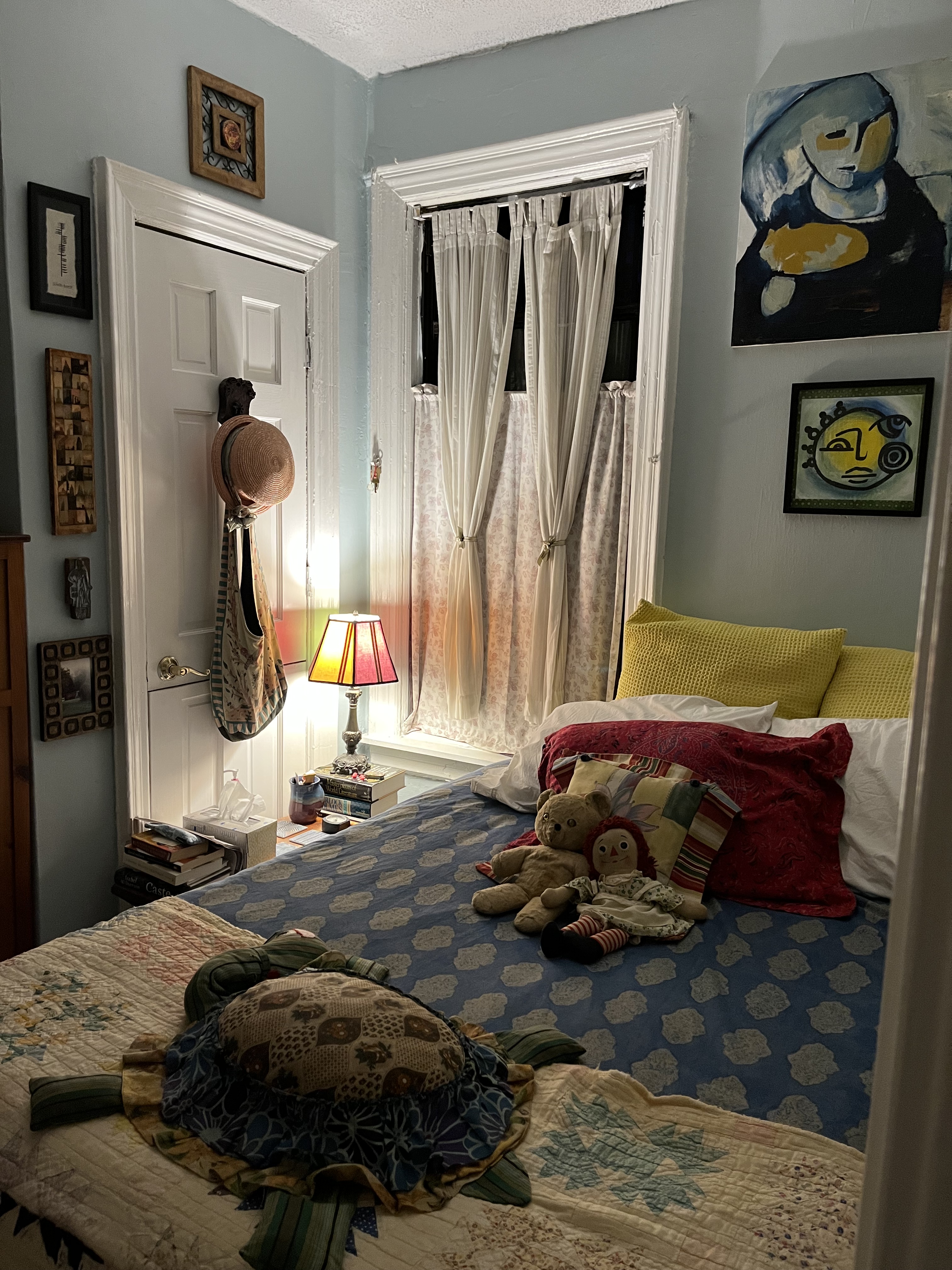
I play with moments. My home aesthetic is born of arranging found and received objects, such as cards and gifts and rocks and pins and books, into vignettes. I play with moments, dimly lit. (I’m not sure I illuminate anything.) Each item in my place came to me at one moment or another, and I assemble and reassemble these moments on my shelves like a story, as I do in my mind, or in a blog post. If I make any “art,” this is about it. I’m not sure there’s any there, there, to paraphrase Gertrude Stein. I wish I were capable of greater depth, of making real art, for example, but I’m limited to the appreciation of, and at best the arranging/displaying of, the art that others make. (Flashing Sign #3, in red, “inadequate and alone”; very few people see it.)
Miss O’ at home, with foot.
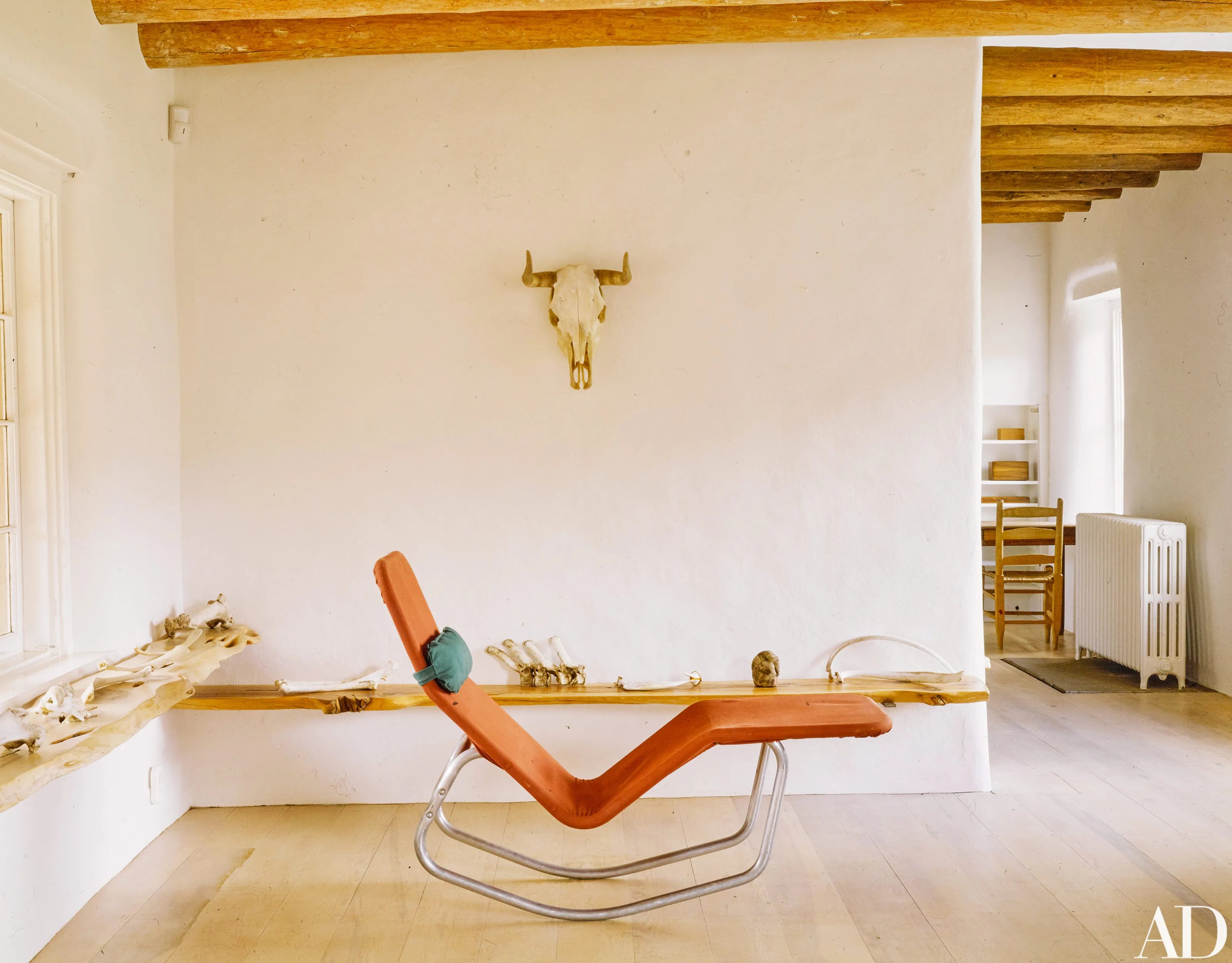
Whenever I look at pictures of Georgia O’Keeffe’s home in Abiquiu, New Mexico, however, I find myself dreaming that I was that person, content with one lovely stone, a clean old bone, a simple wood slab of a table, white walls, bright natural light, maybe two wooden chairs, a desk, a sculpture, one painting.
The way I live, in reality, couldn’t be more the opposite of that. I’m not entirely sure why. Something about a need to feel cozy, to not lose a single memory.
More dimly lit whimsy, with original art from all over, arranged just so.
When I started blogging several years ago, on Blogger, I made it my weekly task to hold in my mind all the disparate things that caught my whimsy and use the writing task to arrange a sort of pastiche/synthesis (since the post-modern world is essentially collage) to see if I could find the connective tissue (sorry—mixed media, mixed metaphors) to somehow point to solutions for the troubles of the world. It all came down to education. Everything does. Not merely knowing a lot or being smart, but rather making connections among the things we learn to try to do something with it, to use it, to put in service to something.
I’m not sure that I accomplish anything, and yet I persist, as I’ve noted before. I had a high school friend who always introduced himself with his IQ, 185, and when I reconnected with him decades later, he was still doing that, as if stuck on a tape loop. (Am I stuck on a tape loop? See also, “feeling alone and inadequate.”) Where do we find the inspiration to grow and change?
Speaking of tape loops, I often return to this little gem. Sir Peter Brook died 7/2/22 at age 97. (For best results, substitute “Life” for “Theatre.”)
Dimly lit whimsy: More and more I find myself writing in the dark. Less and less to say. Amidst so much chaos, so much violence, so many opinions, causing, ironically, so much isolation, where to? And like me, I suspect we all desire not so much “quiet” inside ourselves as stability in our outer lives.
From Instagram.
I believe this is important. Without stability in our most basic living, it’s hard to become outer directed. And if we don’t create a stable center and combine with a contained fire of purpose, the nihilists win.
Seen on the web. People are funny.
In the meantime, as that fucking app reminds us, we eat, we drink. Possibly we read. We watch the January 6 hearings. We vote. Stream a show to binge watch. But there has to be more inside us. And it wants to come out.
So here’s a call to action, to us good, caring folks who need to get off our asses and do what needs to be done, somehow. Right after this heat wave passes.
Lawn chair in O’Yard, ca. 1970s. Doodle by Miss O’, who reminds you to conserve energy and stay hydrated. For all of us.
It was nearly 60 degrees in Queens yesterday; it’s snowing this morning. This has happened two weekends in a row. I’ve been thinking a lot recently about turbulent flow, the reasons for which I’ll get to, but first I’d like to open with an apology for my own flow: I used to be funny. I used to have a capacity to write about things in an energized and witty way. And then that one guy became “president” in 2016, the world turned upside down, as Americans started voting against their own best interests, hell, their senses, and in direct opposition to their self-proclaimed Christian faith, and called it righteous; Earth started turning on us in earnest in response to our neglect of our responsibility to be stewards of the planet, i.e. to not shit where we eat, and our abject failure to do this. I can’t walk down the aisle of a supermarket, department store, or dollar store and not think, “All this is heading directly to a landfill, and there are millions more aisles like this of packed shit none of us need, not a bit of it,” and I start weeping.
Tile adorning my bookshelf, gift from Colleen Cosgrove 2022
Written around the same time:
This past Monday I spent part of the day chasing down a running toilet. I heard the telltale hiss, on for 15 seconds, off for 10 seconds, through some stack in my kitchen; down in the basement it was louder. It wasn’t my toilet—the source was somewhere else in the building. Around 8:30 AM I emailed my immediate neighbors in my small complex, and they too heard the hiss. A couple next door heard it at 11 PM the previous night, and all night, but had been too tired to do anything about it. Next, I sent a group email to the other 16 units: Hi, everyone…anyone got a running toilet? Some replied that they thought is was related to our dysfunctional boiler and steam heat hit and miss; but the fuel company guys (whom another board member—that’s right, I’m on the Board! —chased down at the same time) assured us there couldn’t be any connection. Running toilets are more than just annoying sounds; it’s a water leak and the money adds up. In a small complex like ours, it’s not something you can ignore, but we all want to, don’t we?So finally the culprit revealed herself in a private email to another Board member. Sheesh.
Later that week:
At the supermarket this afternoon, I introduce a little turbulence into the normal flow of a cashier’s day: My order comes to $21.86. I have a $50 bill I want to break, but I already have a lot of ones and pennies, so I give the cashier, a Muslim woman around age 40, I’d say, $52.01. She has finished bagging my groceries, placing them in the bags I brought (this act used to cause turbulence, but not any more, so that’s progress), and as I hand her my odd cash I explain, “I’d like even change.” She looks confused and says, as I suspected she would, “But your total is $21.86.” All I could say was, “Trust me.” “Okay…,” she says, and taps in 5-2-0-1. She turned to me with wide eyes after seeing “30.15” come up on the little screen. “How did you do that?” she asked. “I used to be a cashier, and back in my day we had to figure out the change up here,” I explained, gesturing to my head. I took my 10 and 20 and nickel and dime and put them in my wallet as she said, “I always tell my kids, you got to learn the math,” and I agree, saying, “This is when it comes in handy,” and we exchange “have-a-nice-days,” and I hope we will. Turbulence as magic.
Back to the present, March 20, 2022, the first day of spring.
Tasks of Note:
Got my taxes done this week. For many years it was the EZ form for me—small income, no mortgage, as I was a lowly public schoolteacher who would never see $60K. Now in NYC, at a corporate job and with a co-op apartment, so many forms, I needed help. But what used to take me forever in the way of finding and pulling all the forms is just another task anymore, whatever the technology needs are to make it happen.
Washing coats and scarves, another task this week, used to be an event to me; now in my late fifties, I just wash the coats one day. Hang them up. Go on to the next task.
Baking sourdough bread and keeping up with a starter was something I found arduous in my twenties, since I moved a lot back then; in my late fifties and in one place for nearly 19 years, I think nothing of making my own bread with a starter. Toss in various kinds of flour, water, molasses, salt. Knead it, stick the round in a greased bowl, let it prove a couple of days. Feed the starter, keep it out to grab yeast from the air, stick it in the fridge. Stir it once in a while and feed it in preparation for the next loaf. Bake a loaf, cool, slice, freeze. Bread for a month. (Thanks to Anna’s husband Michael.)
How Ordinary Becomes Precious
Now imagine all those necessary complex and simple tasks under fire. Imagine the work of your everyday world under mortar shelling, your papers and photos and textiles destroyed, that collapse, life reduced to huddling in a basement for weeks on end, little water, little food, no power. I should have really imagined all this long ago—it should never have seemed “other”—but until Trump’s improbable rise and Putin’s recent mental crack-up, I guess I just didn’t realize how possible The End is now. How probable. And what’s worse is 40% of my own fellow citizens would take Putin’s side and kill people like me with abandon. Seeing the footage from Ukraine, in cities that look like New York, it’s surreal and all too real.
You’d think, with all the natural calamities that flesh is heir to, that in 2022 we’d have just fucking stopped war, that we’d unite globally to save the planet that we have trashed. Every generation, though, seems to become simultaneously more evil on the one hand and more evolved on the other. The divide widens. The turbulence increases.
On his death bed, the physicist Werner Heisenberg is reported to have said, “When I meet God, I am going to ask him two questions: Why relativity? And why turbulence? I really believe he will have an answer for the first.” (It’s quoted in Chaos by James Gleick, but I’ve read that the quote is probably apocryphal, so I guess that by continuing to possibly misquote or mis-attribute such a quote we only add to the chaos. We do not, however, lose the intelligence or humor of it, so does it matter? Dammit.)
Being in this Moment
I, the pagan Miss O’, follow blogger John Pavlovitz, a pastor and writer, who is himself a devout Christian whose political writings rail against the co-opters of faith as a means to destroy others and gain money, power, or fame for themselves. In one his blogs from 2020, “I Don’t Want Unity with Hateful People,” he writes:
I am not morally bound to make peace with a heart that dehumanizes other human beings because of the color of their skin, their nation of origin, their gender, their orientation. And to have embraced Donald Trump now, is to unapologetically brandish such a polluted heart; to be actively perpetuating inequity and stoking division and manufacturing discrimination in this very moment.
I steadfastly refuse such an alliance. I am a loud, conscientious objector in their war against the world.
More recently, Pavlovitz wondered why it is that all these “Christians” believe God will protect them from a deadly pandemic without the need for masks or vaccines, but somehow still feel the need to carry a concealed weapon everywhere they go. I mean, which is it?
The trick for the rest of us, then, the ones who wrestle with it all with compassionate hearts, is how to keep the flow of life going on a planet inhabited by not only good people but also by hateful, hypocritical, destructive people. In these moments of despair, many people turn to faith, but faith as a concept let alone practice has never appealed to me. So your Miss O’ has been doing some digging lately to better understand why that is.
Krista Tippett, who has been suggested to me so many times by dear friends that I have become a regular listener, replayed an episode from her podcast On Being which featured the Vietnamese Buddhist monk Thich Nhat Hanh, who died recently at age 95. Hanh was such a powerfully popular figure in spiritual circles that I decided I should give him the respect of a listen. In the interview, he explains that suffering—all this agony and despair—is part of the point. In Christianity, for example, people are promised that in death they will be sent to a place where there is no more suffering. Hanh does not accept this in his mindfulness practice.
Thich Nhat Hanh: Yeah, because I could not like to go to a place where there is no suffering. I could not like to send my children to a place where there is no suffering, because in such a place they have no ways to learn how to be understanding and compassionate. And the Kingdom of God is a place where there is understanding and compassion; and therefore, suffering should exist.
Tippett: That’s quite different from some religious perspectives, which would say that the Kingdom of God is a place where we’ve transcended suffering or moved beyond it.
Thich Nhat Hanh: Yes. And suffering and happiness, they are both organic, like a flower and garbage. If the flower is on her way to become a piece of garbage, the garbage can be on her way to becoming a flower. That is why you are not afraid of garbage.
(So, Miss O’ understands him, turbulence, suffering, garbage—it’s all part of the experience of living. )
Hanh continues:
I think we have suffered a lot during the 20th century. We have created a lot of garbage. There was a lot of violence and hatred and separation. And we have not handled — we don’t know how to handle the garbage that we have created, and then we would have a chance to create a new century for peace. That is why now it’s very important for us to learn how to transform the garbage we have created into flowers.
Tippett: I look at the violence that marked the world in the period when you were a young monk — there was the Cold War; there was a certain kind of violence and hostility. A lot of that has changed, has gone away, a lot of the terrible threats and the sources of the worst fighting. And now in its place we have new kinds of wars and new kinds of enemies. I’d be really interested in, as you look at this period of your lifetime, is there any qualitative difference between the violence that we have now and the violence that we had then? Is there anything like progress happening, or is it the same pattern that repeats itself?
Thich Nhat Hanh: Yeah, you are right. It’s the same pattern that repeats itself.
Tippett: And does that make you despair?
Thich Nhat Hanh: No, because I notice there are people who are capable of understanding, that we have enough enlightenment, and if only they come together and offer their light and show us the way, there is a chance for transformation and healing.
(And within weeks of the replay of this podcast, it’s worth noting, Putin invaded Ukraine, upping the garbage quotient exponentially.)
Miss O’s own qualm with the art of mindfulness is that it seems, somehow, incompatible with joy, humor, ecstasy, agitation, and fun, and synonymous with silence, chanting, bells, quiet, slowness, and dullness. This is not fair, and surely not accurate, but I’ve never heard an interview about the need for mindfulness that includes even one chuckle. And the second I hear Eastern chants and gongs, I think to myself, No.
And so it is that I’ve come to understand that humor is, essentially, a response to inner turbulence; that without this turbulence there would be no reason for humor, no reason to laugh, and life without laughter is…what? And where does faith fit in? And what about the role of art in our lives?
And like MAGIC, my friend Kevin Townley, a practicing Buddhist and teacher as well as actor and writer and Met Museum tour guide, came out this month with a wonderful, funny, deep, personal, and insightful book to help guide me to a new understanding: Look, Look, Look, Look, Look Again: Buddhist Wisdom reflected in 26 Artists.I’m only a third of the way through, because I’ve found I have to read it with my pencil. The best books require that—so many observations to underline and reflect on. “Most people who embark upon a spiritual path don’t do so because they’re feeling fabulous,” he writes. And I laughed out loud. And so I came to see that the reason religion or a practice of any kind seems negative to me is that people seek faith for a release from depressive habits and feelings. So it makes sense, really, that it was hard for me to equate Buddhism, as I said, with joy. Kevin manages to link his irreverent humor and love of art with his spiritual practice, and in writing about it he threads in joy and creates openings for skeptics like Miss O’. Thanks, Kevin.
Miss O’ holds her very own copy, and you can, too, if you want!
Why relativity? Why turbulence? Artists often seem to hold the key. There is a Ted Talk on the unexpected math behind Vincent Van Gogh’s The Starry Night, a painting I have seen in person at MoMA here in New York, but it’s usually so crowded I’ve never had a chance to really see it. This talk, written by Natalya St. Clair, will blow your mind. In turbulence, “Big eddies transfer their energy to smaller eddies, which do likewise at other scales…,” and scientists have discovered “that there is a distinct pattern of turbulent fluid structures…hidden in many of Van Gogh’s paintings.” Gogh know! Artists are the reason to live.
“Seek and Ye Shall Find, and then
…when you find, you will become troubled; when you become troubled, you will be astonished, and rule over all things.”
~ The Gospel of Thomas (one of the Gnostic Gospels that the papal crowd decided to pull out of the New Testament; because god forbid a person feel empowered without a pope to lead her)
So I have to wonder: could the purpose of turbulence be that there is beauty in turbulence? And without turbulence we have no beauty? That Hanh is right, that without suffering there can be no joy?
Last week I noticed the bird’s nest under my neighbor Bob’s second floor air conditioner, a nest that has been there every year for the past 18 years; the chirping heralded spring, and I remembered: baby birds are coming. Then two days ago I looked up and the nest had vanished. Wind? Rain? It’s happened before, somehow the nest is gone, but miraculously, resiliently, the house sparrows are not. There they were, out flitting on the fence, and I saw one fly back up with a small twig in its beak. Rebuilding.
Ukraine will be next. And the earth after that. Take a memo.
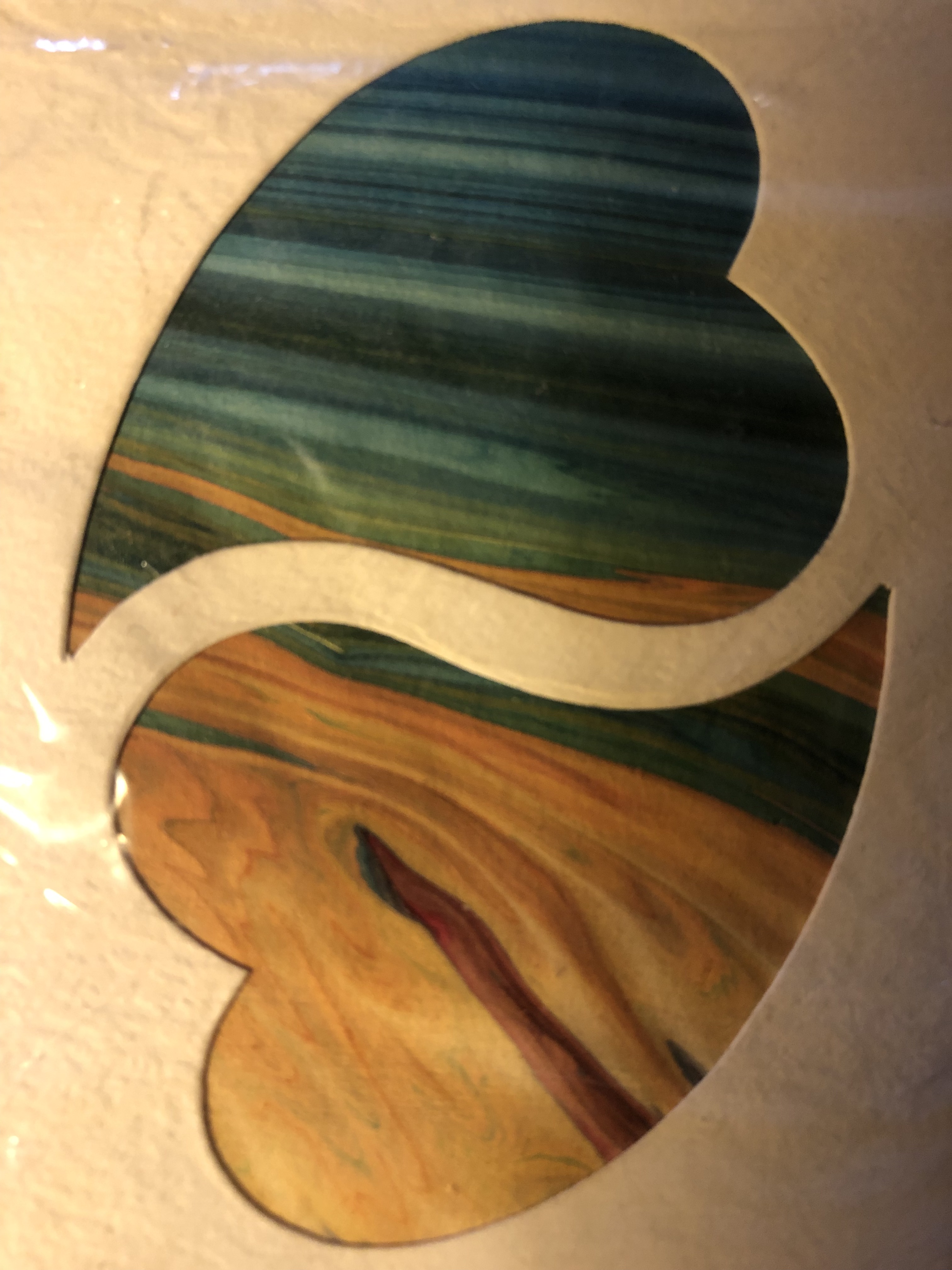
Card by Turkish paper marbling master that reminds me of the symbolic colors of Ukraine.
“Eighty percent of life is showing up.”
~ Woody Allen
“Show Up: Collage by Miss O’, June 2017
Public:
From the Middle English publique, from Anglo-French, from Latin publicus; akin to Latin populus people
First Known Use: 14th century
(Source: Merriam-Webster online)
Back when we the aspiring wrote our first serious essays for public view in high school, one of our classmates would have the novel idea (novel for a 15-year-old) of opening the essay with a dictionary definition of a key word, such as “stream” or “consciousness,” say, to start off the proceedings. Other eager writers, deeply impressed, would then copy this technique, and at some point during the year, after reading dozens of such openings, your teacher would write in red on your essay, “You might try another approach.” Deflated, for you were really excited to try out your brilliant classmate’s technique for yourself, you nonetheless pushed yourself to find a unique way into the next essay. The same happens when we in the theater direct classic plays: We can’t repeat the same old formulas when approaching a classic, because what was old needs to feel new again: Artists look at a work by, say, Shakespeare, and ask themselves, Why this play? Why now? What could we do to bring it to life in the modern age, make it contemporary and meaningful to today’s theater-goer? Sometimes it works, this novel approach, and sometimes not so much, but one of the best things about art, even if done without easy success, and maybe especially then, is that it gets us, the public, talking about it.
So with all that in mind, and given the current controversy over the Public Theater’s production of The Tragedy of Julius Caesar in Shakespeare in the Park in New York City (and can I get a “Hail, Caesar”?), it seems a definition is in order. According to the Merriam-Webster Dictionary online, here are the definitions of public:
2a: of, relating to, or affecting all the people or the whole area of a nation or state public law b: of or relating to a government c: of, relating to, or being in the service of the community or nation
4: of or relating to business or community interests as opposed to private affairs :social
5: devoted to the general or national welfare :humanitarian
6a: accessible to or shared by all members of the community b: capitalized in shares that can be freely traded on the open market —often used with go
7: supported by public funds and private contributions rather than by income from commercials public radiopublic television
Your Miss O’ here hasn’t seen the now internationally famous production (free and open to the public (see definition 3a) in Central Park, closing today as they prepare their next offering (A Midsummer Night’s Dream, with Melania as Titania; I kid! Ahem), but I did teach the play itself for all of my 15 years in public (see definitions 2a, 3a, 5, and 6a above) high schools, as an English teacher. The play has been taught nationally since the early 20th century, I learned, as a replacement for what used to be called Rhetoric, when public speaking (see definition 3a above) began disappearing from the school curriculum. Julius Caesar the play is, as was the man himself, fabulously political, which is often unwelcome in America lately because too many Citizens (or Plebians, in Caesar) aren’t terribly educated on the whole about civics (a Greek and Roman idea with a Latin root in the word). Schools, as we know, are competing with lots of stimuli from the public arena (see definition 1a above), and teachers more often than not are having “to fight to teach,” as Miss O’s colleague of many years, Mrs. Little, was often heard to say in the years before she retired.
So what is a public? What is a republic? And what do they have to do with a theater in New York City called The Public Theater? I read yesterday of all these protests attending the Public’s production, protests carried out by a public consisting of people who have probably not heard of the play outside of a vague memory of suffering through Mrs. Ayers’s triple-matching test one semester of their sophomore year of high school (I mean, what the hell?). Doubtless the protesters of the Public had never read the play with anything like understanding, let alone seen a live production, or even sat through the entire movie with Marlon Brando in the pivotal role of Marc Antony.
What they are missing—and what anyone up in arms (an idiom which was once quite literally about raising ones weapons) about this event is missing—is knowledge, both of the subject matter and the play. (One could say the same about most any public protest, for one should always know deeply the why of any protest.) It’s easy enough to Google both the man or the play in Wikipedia (and anyone reading this blog won’t need to, more than likely, which is the futility of writing blogs like this), but chances are that even still, most Americans probably know more lines from it than they realize:
Friends, Romans, Countrymen, lend me your ears…
…let slip the dogs of war…
Though last, not least in love… (“last but not least”)
Those might surprise you—these everyday things. Here are others, seen online:
Beware the ides of March. (1.2.23), Soothsayer
Et tu, Brute? Then fall, Caesar! (3.1.77), Cæsar
Friends, Romans, countrymen, lend me your ears;
I come to bury Cæsar, not to praise him.
The evil that men do lives after them;
The good is oft interred with their bones;
So let it be with Caesar. (3.2.79-83), Antony
It was Greek to me. (1.2.289), Casca
Cowards die many times before their deaths;
The valiant never taste of death but once. (2.2.34), Cæsar
This was the noblest Roman of them all. (5.5.75), Antony
Men at some time are masters of their fates:
The fault, dear Brutus, is not in our stars
But in ourselves, that we are underlings. (1.2.146-8), Cassius
This was the most unkindest cut of all. (3.2.193), Antony
Let’s carve him as a dish fit for the gods. (“a dish fit for a king”) (2.1.173), Brutus
Not that I loved Cæsar less, but that I loved Rome more. (3.2.23), Brutus
What Julius Caesar is, though, beyond the quotes, is a fascinating study in the greed for power desired by a few men who would lay waste to the land, their institutions, and the people they would lead in order to attain more of it. It’s a study, too, in the use of language, of rhetoric, to not only persuade but also hoodwink a crowd with conspiracy theory, getting the crowd to do the looting, killing, and army work in order to feed the hunger of one man’s desire for power. In other words, it’s an instructive play, and it’s a hard play, and its themes are and remain universal across civilized societies everywhere. And it took me years to understand it and to love it. That is Shakespeare for you. That is life for you.
The Public and the Republic
Should you care to, there’s a solid Wikipedia article on the meaning of republic, and it’s worth a look at the history. At the time the play is set, and in real life, Julius Caesar was the head of the Roman Republic, which republic was an exercise in representative government that carries over to our American Democratic Republic today. At the time Shakespeare’s play begins, Caesar was about to be crowned emperor by the people, and the concern of the play is, and remains, our own concern today: Can we have representative government of the people with a king in charge, however idolized by the general populus? And is assassination (a word that first appears in print in Shakespeare) of the man who would be king ever the right choice? (Hint: No.) And why are crowds so easily manipulated and so goddamned fickle? The rise of Marc Antony is especially chilling. If you read nothing else, read Act III of the play: The assassination, the aftermath—ring leader (and yet noble) Brutus’s hasty act and unrehearsed speech, Antony’s vengeful use of that speech in his own rhetoric to turn the crowd to “mutiny”; and finally, the shocking turn of the grieving Antony into the gleeful victor as the crowds tear away on a killing spree: “Mischief thou art afoot. Take thou what course thou wilt.” In Act IV, he has his own nephew killed. And we and the people learn the hard way: Great a speaker as he is, devoted to Caesar as he is, Antony is really only loyal to Antony.
Coming Up Trumps
Yet another Shakespeare play resembles the present age of American politics: it’s Richard III, only with a president who is infinitely less intelligent if no less mentally unstable than Richard. But what the two have in common is a desperate need for power, accolades, and above all loyalty. Watch Al Pacino’s wonderful documentary and filmed version of scenes from the play, Looking for Richard, and you’ll see what I mean. And another Shakespeare play that comes to mind, in a painfully diminished form, is King Lear, where the old king divides his empire among his three children, demanding from each supplication and eternal devotion. And we all know how that turned out. Or we should—and it’s why education and the arts matter, matter, matter. Goddammit anyway. Because if you’d just read Shakespeare, you’d see that not only have we seen all this before, we saw it in language so far elevated above the National Tweet it makes your head do a Spicer spin. And yet Shakespeare might make some people feel, you know, stupid, or put down, because anyone can understand a tweet. And isn’t that all we need?
Going Public
“Julius Caesar can be read as a warning parable to those who try to fight for democracy by undemocratic means. To fight the tyrant does not mean imitating him.” – Oskar Eustis
Photo by Miss O’ from the Staten Island Ferry, June 2017
The Public Theater (see definitions 1-7 above) is a terrific institution (https://www.publictheater.org), if hit-or-miss in terms of quality, so that the same theater that gives you Hamilton and Fun Home also gives you David Byrne’s (“not ready for prime time at ALL” according to friends) Joan of Arc and, according to some reviews, this production of Julius Caesar (Read Oskar Eustis’s statement here: https://www.publictheater.org/Julius-Caesar/). As to hit-or-miss: Who cares? Life is hit-or-miss (just ask our president and his two ex-wives, and probably his current wife, to say nothing of the business owners he screwed over), and unlike those folks who tell you “life is not a dress rehearsal,” Miss O’ would argue that life is ever that. It’s an experiment, and it requires engagement, adjustments, rethinking, and, sometimes, new costumes to keep up with the fashions of the times. It’s also worth remembering that, as Oscar Wilde said (pardon the cliché), “Fashion is a thing so hideous we are forced to change it every six months.” And most politicians, too, can and do become hideous—hence the need for term limits.
Speaking of term limits, most plays have a limited, and often terminal, run. Modern productions reinvent classic plays for a new age, and they, too, have a limited run. And this president, provided we don’t have an assassination attempt, a military coup, or war to end all wars, will also have a limited run. He’ll be sent packing, or will leave of his own accord to start up a TV network, or die of heart failure in office, or walk clumsily out after Inauguration in eight years, red necktie beating his face, as he heads to his gold-plated jet for rich living in his Tower till the end of his days. It’s a crapshoot, and yet we have to keep playing craps.
How many ages hence Shall this our lofty scene be acted over In states unborn and accents yet unknown?
~ Cassius to Brutus, Act III, scene i, Julius Caesar Translation:Karma is a BITCH.
The personal is political, as the feminists say, and the political becomes personal, in the best and worst ways, depending on the will of a fickle public. I took a trip to Ireland in April and noticed that there really was a pub, or public house, on every corner, and it’s not hard to see why. We could use a drink. The Irish know that as well as anyone.
At Aggie’s Pub in Killea, Dunmore East, Ireland.
And a TRIP. Travel, for goodness sake. Travel. Get out of yourself. I can’t tell you how much better I felt about life, both during and after Ireland. Show up to life, sure, and then pay attention. And the more we, the people, can venture out and gather in public and LISTEN as well as protest, the better chance we’ll have to weather this latest political tempest. Ask Ireland about The Troubles, for crying out loud. This is nothing, I tell ya. And still we have to DO something about ours. So do that, and in a democratic way.
Sending love to all,
Miss O’
The Ring of Kerry, view, Ireland. It took the Irish 400 years to gain their independence from Britain, the empire that captured and subjugated everything and everyone, except the little island next door. These are my kind of people.
Today is Martin Luther King Day, and I am home with a holiday from work, able to write because of this great loss of life. So let us begin with him:
“Darkness cannot drive out darkness; only light can do that. Hate cannot drive out hate; only love can do that.”
~ Martin Luther King, Jr.
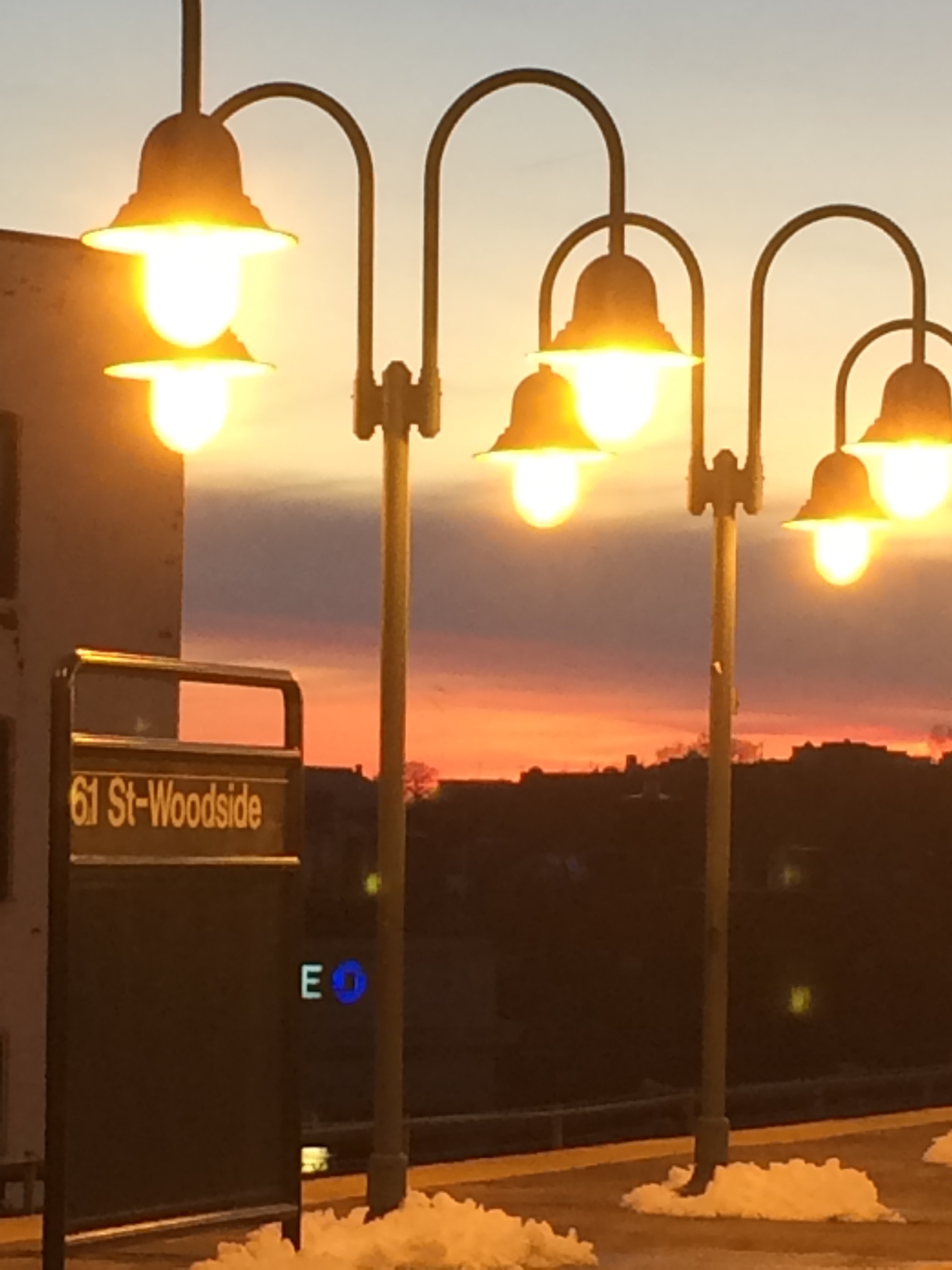
61st St. Station, Woodside, Queens. Photo by Miss O’
“Never are voices so beautiful as on a winter’s evening, when dusk almost hides the body, and they seem to issue from nothingness with a note of intimacy seldom heard by day.”
~ Virginia Woolf, Night and Day
Public Theater
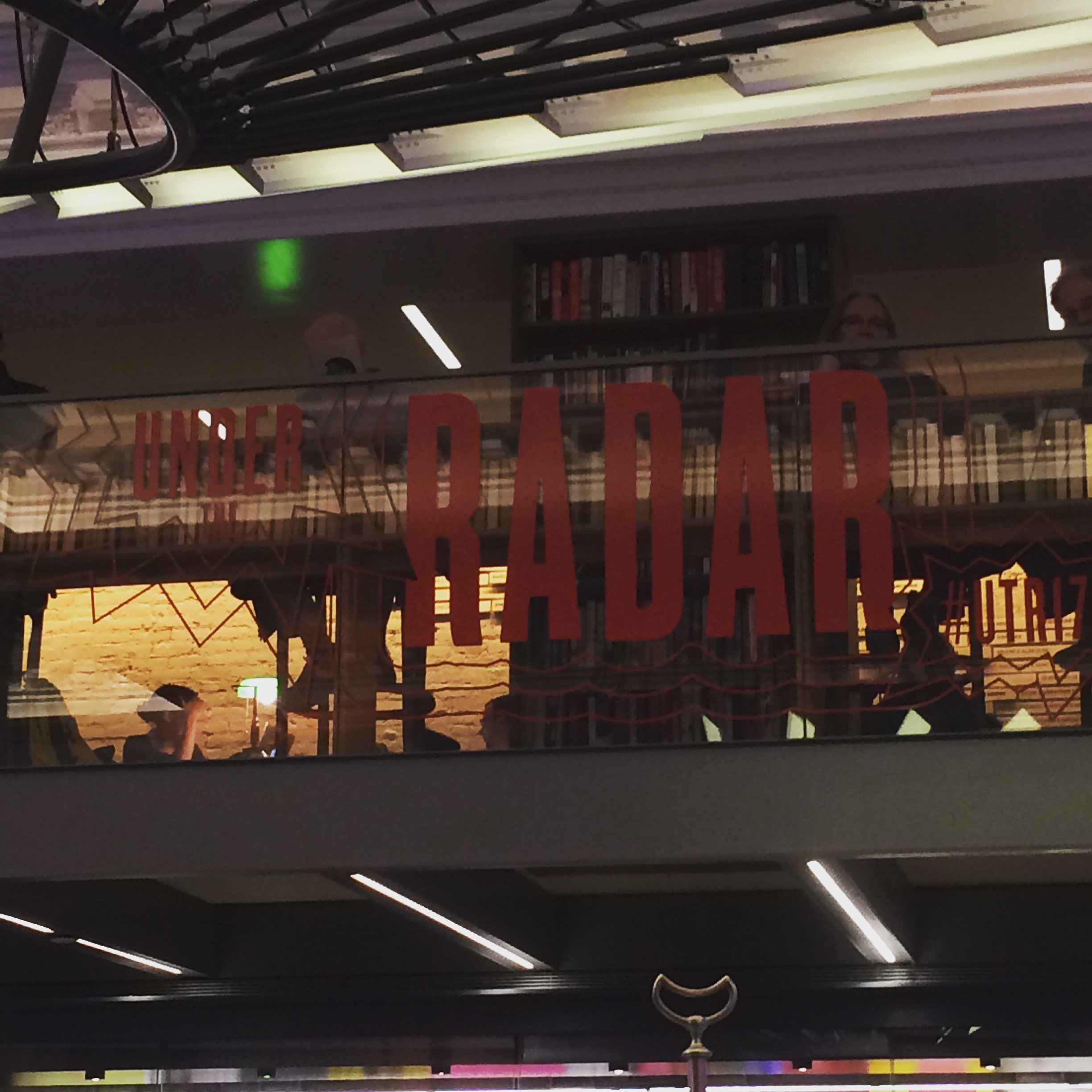
The other night, Friday, I went to the Public Theater’s Under the Radar Festival’s presentation of Lula Del Ray by Manual Cinema based in Chicago. Such an unusual and simple story—an adolescent girl living with her mom in a trailer in the desert in the 1960s at the time of the space launch—but its chief feature was that it was performed live, with musicians, actors, technicians, and overhead projectors. Remember those? Miss O’ used them as a teacher nearly every day. The result of the layered images and slowness and music was that you experienced a whole interior world, so that each moment—from swinging feet while sitting on a rock ledge, to sleeping in a hammock, to listening to a record of two young country stars—became significant.
Public Theater. Photo by Miss O’
Before the show, sitting in the Martinson Theater at the Public with friends Heather and Bettina, we began talking politics, and I railed about the week’s events, including the votes to repeal the Affordable Care Act, which many Americans know as Obamacare, but don’t realize they are one and the same. So vociferous did I become, an older woman in front of me turned around, and I said, out loud to myself, “Lisa, shut up, you’re in a theater about to see a nice show, so please, just STOP with the politics!” And I laughed. I leaned down to the woman and said, “I am so sorry,” and she said, “I was just thinking that this is the conversation I have with my friends all the time.”
Taking moments to breathe: So important. Before the show, I’d picked up a turkey and brie Panini at a deli called Bully’s on Broadway, and had leaned against the Public’s stone facade to eat it. Outside in the chill dusk, staring into the buildings across the street, all that glorious architecture, made me calm but also inquisitive, contemplative. In one of the tall bright windows sat a slender young-looking woman in a sweater, short hair, bent over a desk, who appeared to be drawing. She did this steadily the whole time I chewed, slowly, bite after bite. New York is full of lives, millions of them, behind facades both material and emotional, working out things we can’t even imagine. Sometimes it’s nice to sit and contemplate only one of them, and I found it restful.
And as I write this I realize that my observation, of what was a kind of silhouette of a moment in a stranger’s life, was very much like seeing Lula Del Ray, and there was both emotional connection and distance, both cogitation and peace in each act. And this theater piece had something else: Romance—the romance of the desert, of being young, of listening to records, of space flight and flights of imagination. Also disillusionment, followed by, you know, growth. I miss romance. Thank goodness for books.
The gift of books from friend Tom Corbin.
Writers Resist: Louder Together
“ORWELL KNEW”
~ Protest sign at PEN rally, January 15, 2017
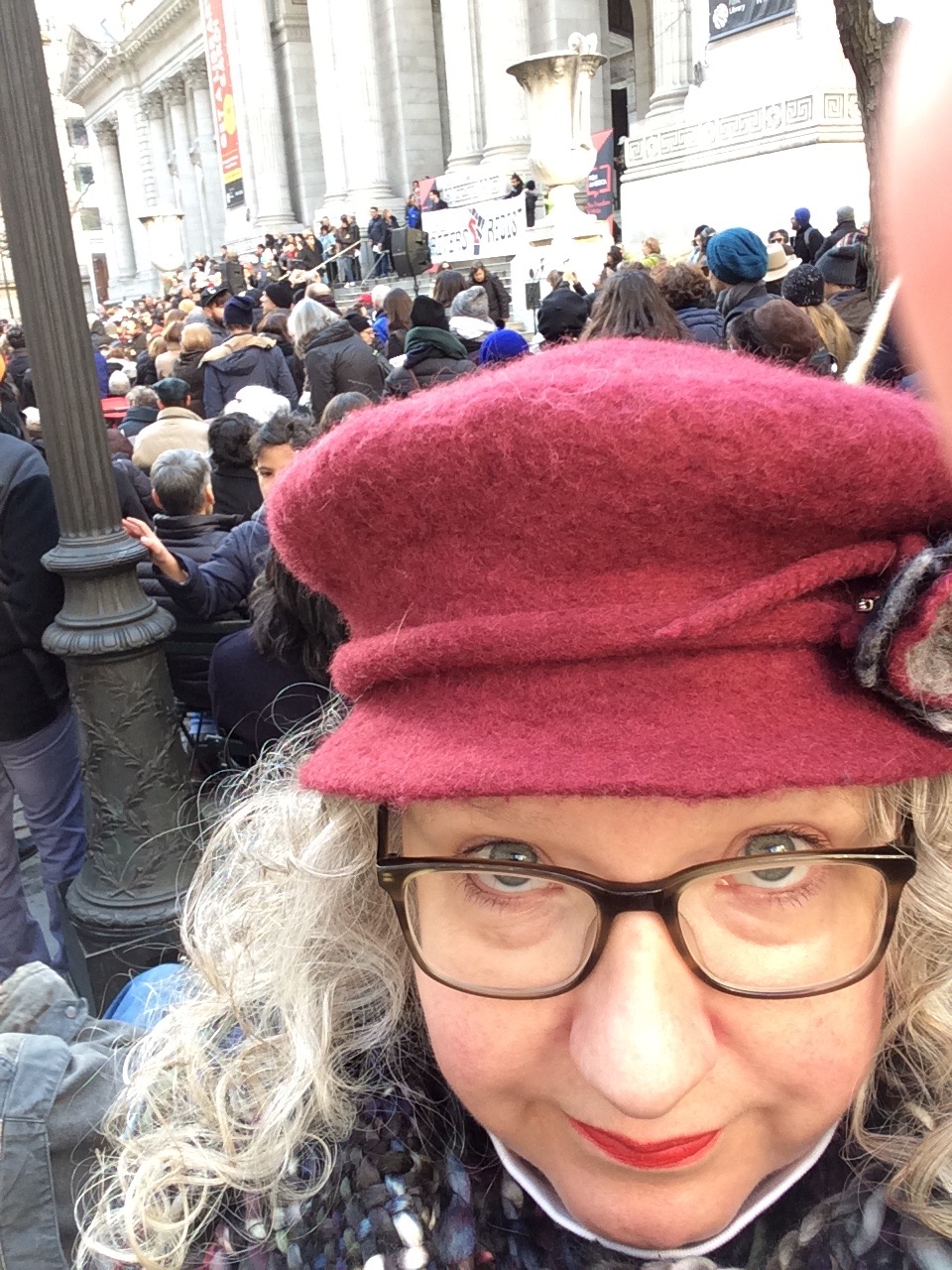
So in this most UN-romantic of times in America, I want to write about “Writers Resist: Louder Together,” the PEN Rally for Free Expression I attended at the New York Public Library, one of many set for Sunday, January 15, 2017, at libraries across the country, but I can’t stop laughing to think of it. Before I explain, let me say that PEN is a great professional writers’ organization, and while I’ve never been a member, it’s famous for a lot of great work to do with the freedom of ideas. It’s expensive to join for most people, given that unless you can fully participate, and who has time, it acts essentially a charity to promote literacy for other people, a charity about which almost no one will ever hear, which says so much that is ill about this nation. And given how powerful PEN might be at time when President-elect Trump is talking about removing the White House Press Room, the disappointment I felt—no, the agitation and annoyance I experienced at this PEN event—were couched in irony.
First off, you should know that the vast majority of writers in the world are not speakers—neither are most people, but at least writers use words for a living. Writers are introverts, for the most part, so you see where this is going. They are more than a little freaked out by crowds. Volunteers at the event were not, therefore, really “people” people, so would ask us, either sheepishly or with irritation, “Are you a speaker? No? Then you need to be over there; this area is for speakers.” (I placed a semicolon in that last sentence because I do think writers would think of their speaking in terms of punctuation.)
So what did the organizers do with their speakers at this big RALLY FOR FREE EXPRESSION? Did they open with, say, a rousing contemporary song about the world today, sung by someone interesting in terms of body and background? No. They opened (one imagines to establish patriotism, however unimaginatively) with “The Star-Spangled Banner,” sung by a slender young white soprano with long blonde hair. You can’t make this up. Was the first speaker a rousing, stirring voice of a generation? No, it was long-lived Rep. Jerry Nadler, from Congress, greeting us on the plaza (this placement making it hard to see him) with a flat, well meant, and staggeringly rote commemoration of Dr. Martin Luther King, Jr., as a kind of invocation, but the sound system made it hard to hear him. Did PEN then have the speakers speak from the microphones placed high on the steps? Nope. Each speaker spoke from what appeared to be (at best glimpse) a handheld mike on the plaza level, where only a few dozen could get a view. I sighed as I stood in a small puddle, getting shoved by short old women in interesting hats trying to get a better view. Everyone around me was white. Everyone as far as my eye could see seemed to be white, until I saw two Asian women, one old, one young, to my right. Some clapping happened. Did any speaker within the first fifteen minutes of the event deliver a rousing call to demonstrate that “the pen is mightier than the sword” and that our voices together made us louder and stronger, and tell us this from high up? I must say no. No one around me could hear or see him/her/it, whenever. The crowd, with no trace of irony given the title of the event, kept crying, “Louder!” And no one in authority heard them.
Miss O’ resists…screaming.
Was there anything amazing after the first fifteen minutes? I couldn’t tell you. I left the plaza and this surreal event and started walking up Fifth Avenue, muttering, “This is idiotic,” when I heard two white (of course) women about my age in front of me, talking good-naturedly about how they couldn’t hear anything and had decided to leave. I touched one on the arm. “Forgive me, but I couldn’t help overhearing, and I feel the same way.”
I went on as we paused there on the sidewalk, “I’m a theater person. How on earth can a group of introverts, one speaker more decrepit and whispery than the last, hold a rally? Why aren’t they talking from the top of the steps? Where was the big opener?” Here I mimed a cigarette and a New York rasp, “What they need is a director!” The women laughed, agreed, and at least this moment of communion felt real. I headed toward the subway steps at Bryant Park, contemplating my next move, when I heard the women laughing again, in agreement, repeating what I’d said. I felt a little bad, because here a great organization planned a vital rally, and all I could do was criticize. I don’t need Bread and Circuses (and this week I read that circuses are, finally, going the way of the vaudeville), but I expected ENERGY, and words expressed as ART, at a rally like this. It was strange. And, unlike the teeming world of the surrounding sidewalks, so, so, white.
In a quiet, internal response to all this, I, appropriately enough, found myself reciting Brooklyn-born poet Walt Whitman:
When the proofs, the figures, were ranged in columns before me,
When I was shown the charts and diagrams, to add, divide, and measure them,
When I sitting heard the astronomer where he lectured with much applause in the lecture-room,
How soon unaccountable I became tired and sick,
Till rising and gliding out I wander’d off by myself,
In the mystical moist night-air, and from time to time,
Look’d up in perfect silence at the stars.
F Train
Maybe I just needed to go and find my own voice for a while. So at Bryant Park I picked up the downtown F Train to 2nd Avenue and walked around the East Village, because that area of the city helps me think. It’s where I’ve always felt the most “at home” in New York, though I couldn’t tell you why.
Photo by Miss O’
Something about the age of the city, the low-rise buildings, and bars and cafes and unexpected historical plaques; all the theater on E. 4th Street, from La Mama to KGB Bar and the Kraine, to the acclaimed New York Theater Workshop. I always sort of dream I’ll have a show in one of those places.
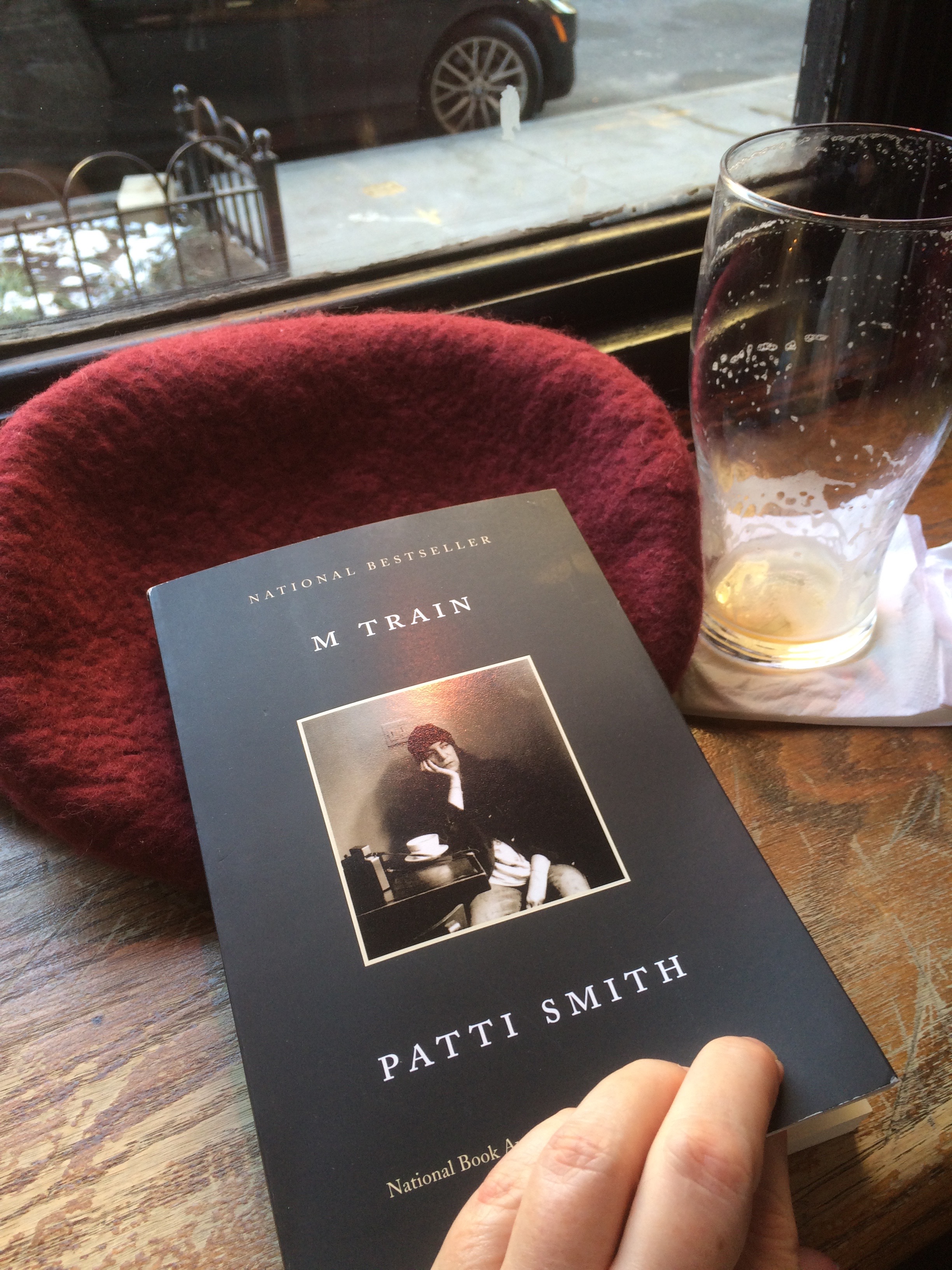
Back on Houston St., when I first got off the F Train, I’d stopped for a hot knish from a real deal Jewish deli before I’d wandered to E. 4th St. I had the bag in my hand when I made my way to Swift, a Hibernian pub (for the second time in as many days, since it’s not far from the Public), where a cracked-leather covered stool in an empty corner by the window allowed me to sneakily eat my contraband knish with a pint of Smithwick’s, and enjoy the light of the window to read more from Patti Smith’s simply lovely book, M Train. From this book (M is for mind) I’ve learned that this revolutionary rocker, fashion icon, iconoclast, and artistic legend has, over her life, wanted nothing more dreamily than to open her own café. These dreams of the simple and communal are not unusual, but they can be surprising in spectacular geniuses. A poet friend—perhaps the greatest living poet that almost no one knows about, Jean LeBlanc—would love nothing better than to have a little shop that sold original arts and crafts and other neat stuff, where she could write more poems as I looked out for shoplifters. We want that blend of society and solitude, the warmth of handmade things, and fresh, warm beverages. Sure, it’s cheaper to make coffee at home, or buy a six-pack of IPO, or eschew material possessions for asceticism, but where’s the romance in choices like that? And, boy, do we need a rebirth of romance.
At Swift, E. 4th St. Photo by Miss O’
Something Curious
This week, as Onion-esque and Kafkaesque as it may seem, Donald J. Trump will be inaugurated as the 45th President of the United States. Rallies are scheduled, marches are happening across the country, and it’s all totally uncertain as to where this country is headed. And as horrified and depressed as I’ve been over the results of this election, I have to admit a curious thing:
I haven’t felt so alive to myself in my adulthood, as I do now, since the first summer I spent, at age 26, at the Bread Loaf School of English, my first summer of a five-summer graduate program. I’m 52, twice that age, and in having something to so clearly fight against, that my own values and morals, my ethos, my art, my friends and their safety—even the everyday sights of New York City—are at stake, my senses have been sharpened by the prospect of horrors to come, as a broadsword by a whetstone. I hope my pen proves mightier than any sword, or sling and arrow for that matter, from this sociopathic right wing. I tend to doubt it, but one must try.
Burst Your Bubble
To white Christian America, the original bubble people, who ironically think that all of us who move to the Big City are in a bubble, when in fact we’ve BURST our bubbles to reinvent our lives and connect to disparate humans from all parts of the earth (thus perhaps making a new bubble, but WOW, what a bubble!), I say this:
Find some old movies about New York. Nice ones. Watch Annie Hall and Hannah and Her Sisters. Whatever you think of Woody Allen, the man is at his best when he focuses on women and the complications of relationships, because it frees him to examine with real curiosity the beauty and intricacies of New York City. With only white people, a handful of Jews, and with a brief appearance by a black, singer Bobby Short, and taking place in the distance of the 1970s and ‘80s, maybe you white small-town folks won’t freak out. It’s romantic, really. For Allen, it’s all about romance. Remember romance?
From Queensboro Plaza, NYC. Photo by Miss O’
Curiouser and Curiouser
The way Lawrence Ferlinghetti was “waiting for a rebirth of wonder,” Miss O’ is awaiting a rebirth not only of romance, but of curiosity. I want to see people looking up and out, talking, listening, reading a fucking book. Collecting small objects of beauty, sending cards to one another, hearing live music, writing of our experiences, or at least sharing a good joke, before the joke on us is one we can’t laugh at anymore.
The most lacking thing for me, the observation that has been freaking me out more than a little of late, is vitriol spewed from mouths, or even hoarse laughter, accompanied by a total lack of affect in the eyes of Americans—a kind of deadness while the mouths move, however nastily or in mirth—and I demand to know, Where are the flashing eyes, where are the twinkles? It’s like inquisitiveness and connection to feeling never existed. While we all feel curiosity when it comes to gossip, say, wouldn’t it be lovely to be curious about why we feel and act as we do toward our fellow men and women and transgendered, and for that matter, PLANET? I think yes. Dammit!
So to all I say, Wake up, take up your pens, but also pick up your goddamned feet. Remember when your mom said, “GO OUTSIDE”? Go OUTSIDE. Go to a bar, to a café, for a walk around the neighborhood. Use your VOICE. Now go LOUDER. And also listen. Really LISTEN. And with love. Care deeply! And let me see the romance in your eyes.
Oh, and:
Miss O’ appeals to you.
P.S. LINKS TO STUFF YOU CAN DO TO CHANGE YOURSELF AND THE WORLD
























 The Miss O' Show (Teacher's Edition)