Vamp Until Ready

Playing for Time

Covering a Change

Back when I was a drama director, my school’s orchestra teacher, Mr. T, had to fill in as the conductor of the orchestra for The Music Man when not one band director but two had to bow out (one for a family tragedy, the other because he’d been asked to be an interim principal at another high school). Mr. T, who had strenuously avoided conducting kids in a pit, was a terrific conductor and teacher, but knew nothing about musical theater. One day in the library, where he’d tracked me down, he asked me about a bunch of music on the sheet. Those marks (Greek to me) turned out to be the opening of “Wells Fargo Wagon,” and just as Mr. T knew nothing about putting on a show, I knew nothing about reading music.

He asked, “You don’t need all this music, do you?”

Oh, yes, we do.

“Why? It’s a lot of music.”

Because all this intro music is covering a set change.

“Covering?”

Right—the orchestra plays while we do all this work behind the curtain, or on a darkened stage, and when the lights come up, the music stops. In fact (I explained to the perplexed Mr. T) we will probably need more than that, so you will need to pick a spot you can back up to and play it again. It’s called, Vamp until ready. (And here I sang a little, “Bum, bum, bum, bum” [key change] “bum bum bum bum…” and then, “Now the lights come up and Marion enters…and music fades….”)

To his credit, Mr. T listened, learned, and got it. I was really happy to work with him, and he was in turn grateful to conduct the pit, though once was enough (it’s a 10-week after school time commitment for no pay), because he’d had no idea what went into it or how interesting it was to watch a show evolve in rehearsals to performance. And since pit orchestras are among the biggest employers of musicians, even a high school production of The Music Man is real world work experience for the kids.

I was thinking one morning this week about that expression, “vamp until ready,” which I learned in college as a theatre major under the direction of the late, great Maureen Shea. I used to watch her direct even on shows I had nothing to do with, only one of which was a musical during my four years. (Sometimes, you only need one strong experience to bank away knowledge for a lifetime.) I’ve noticed that “vamp until ready” applies to my corporate work life, and by extension to my life in general right now, but oddly enough, also to world leaders; the question is, How long can we keep this up?

“Figure It Out”

Among the looniest takeaways from all the years of public or private education for Americans in general over the past many decades is the notion that teachers had nothing to do with our learning. Instead, too many who go on to adulthood, especially those who become “leaders,” are under the delusion that they themselves figured out how to read, write, calculate, observe, and think irrespective of the educators they had over the years; indeed, some believe they learned in spite of them (and however much we may not like a teacher, we learn that, don’t we?). Ergo, when these former students go on to lead projects for, say, the government or a corporation, they begin by telling you, the workers, about a vision, the market, and the research, and to explain your titles and roles in the creation of this new initiative or project.

And when you ask, “What do you want me to do, or how can I best be of service?” their standard answer is, all too frequently, “Figure it out.”

Or, worse, “I’ll know it when I see it.”

I believe this is because they, the leaders, know we have to create something, but beyond a pillowy, sparkly dream, they more or less have no idea how to execute it. Or, by contrast, they know exactly what they want to do and give innumerable lectures in meetings trying to get your buy in. Talk, talk, talk, talk, talk until blue in the face. And after two decades in corporate life, where I moved from worker bee to senior whatever, the same thing holds true, whatever the leadership style: No one in leadership gives a tinker’s damn what anyone on my level “thinks.” Nothing we “do” or “make” will ever be what they want because they have zero curiosity about what we on the ground are going through. Life as Monty Python sketch. So, in order not to go mad and to keep your salary and benefits, you learn that the best thing to do is “look busy,” or as we say in show biz, vamp until ready.

And one day, suddenly, the curtain will open, the lights will come up, and the leader will shout, “I need everyone on stage NOW.” And with the wave of a wand, the leader will tell you what they want you to do. Only now, instead of 12 months to make the product, you have one. And you’d better not fuck it up.

Work Until Living

Everything on earth is in crisis—the climate, the untold effects of war and natural disaster, governments taken over by the right-wing march to fascism—and where once we had (we thought) plenty of lead time to solve everything, the time has been lost primarily due to lack of capable leadership, or because good leaders have been thwarted by others devoid of curiosity and compassion and belief in something true. I’m looking at free-press publishers as well as mayors and governors and representatives and presidents. Even good leaders can’t move forward when no one else is cooperating. How many times must we quote “The Second Coming”? The best lack all conviction, while the worst / Are filled with passionate intensity.

But being a lowly worker bee, I can’t lead the world to victory over the latest crises. As a result, I find myself stuck with my own life to figure out. That’s where most of us are.

Where is my leader, I wonder, the one who will announce to me what I’m supposed to do and how I’m supposed to do it and what the deadline is? A lot of us could use a purpose, not life and death, maybe, not with stakes beyond what we can handle and live in joy at the same time, but I mean some kind of purpose that makes the work of living each day something beyond mere survival. Many people have love in their lives, a mate or children, to give them that level of desire for living. Most of us, however, do not. And that’s when we look to art, I guess, whether or not we have talent or direction.

I think, in fact, the worlds of business and government (and even puny human life) would do well to take a cue from the world of musical theater.

At the first production meeting for an upcoming show, the director (in charge of the whole shebang) sits with the musical director, set designer, lighting designer, costume designer, choreographer, and stage manager (and if at all possible the original authors, but I was never that lucky director) around a big table, scripts in hand. First, a good director will share the vision she has for the production. A really good director will move forward by genuinely asking each of the players assembled what they think about the script and score, looking at their preliminary sketches and notes. Next, an even better director listens to each person in turn, not as a courtesy but because she really wants to know what they think. The stage manager takes notes. Perhaps they break for tea and donuts. And if a director is excellent, she will tell back to each of the players all the ideas they shared that she would really like to incorporate. Then she will give them an assignment, which is to take everything they’ve talked about today and make adjustments to their previous ideas; this includes the director. And so the work goes. Ultimately, the director decides on the production concept and must make sure that all the pieces of the production, including performances, are working in concert (the setting not modern when the costumes are 19th century, say). All this work evolves over the course of, say, ten weeks, leading to the technical rehearsal with the performers. The tickets are sold, the show must go on.

Unlike world leaders faced with the problem of war or global warming, or a CEO launching a new, useful product in corporate America, in theater a leader is not allowed to go into denial, sit around making speeches or ringing hands or having drinks with other theater folks before deciding to finally start rehearsals a week before opening night.

There is in the theater what Dr. King called “the fierce urgency of now.” (How is this not true for too many when it comes to war and the planet, when the stakes couldn’t be higher?)

In the months or weeks leading up to an opening night of a show, the work has to be ongoing and purposeful (the theater is booked), the collaborations real (the tickets are sold), the director clearly in charge of pulling it all together. That’s the deal. A show might succeed or flop, but no one is setting out to fail. And the work in any case will help everyone involved be better trained for the next one. And there will always be a next one.

The theater process is worth studying, I think, because while the stakes often feel like life and death, because artists care so deeply about success, the truth is no one dies. All we ever have against us, whatever our job, is time. In the theater, every show needs two more weeks. Because we don’t have it, we go on, we work, we do our best. We don’t give up.

Shouldn’t that be everywhere? With everyone?

More and more, I’m wondering if I’m feeling a crushing sense of my own life off the rails because all around me I sense the director left the building; I feel this enormous lack of sentience, wisdom, and leadership in the larger world. It’s hard to think of my little life having value or meaning when the highest of stakes, life and death issues, are being played for farce among, say, elected Republicans in our House of Representatives, where the instigators receive no rebuke in the headlines (while “the slap” gets unending coverage). How long can we keep up this vamp before the audience in fact dies?

Troubling Deaf Heaven

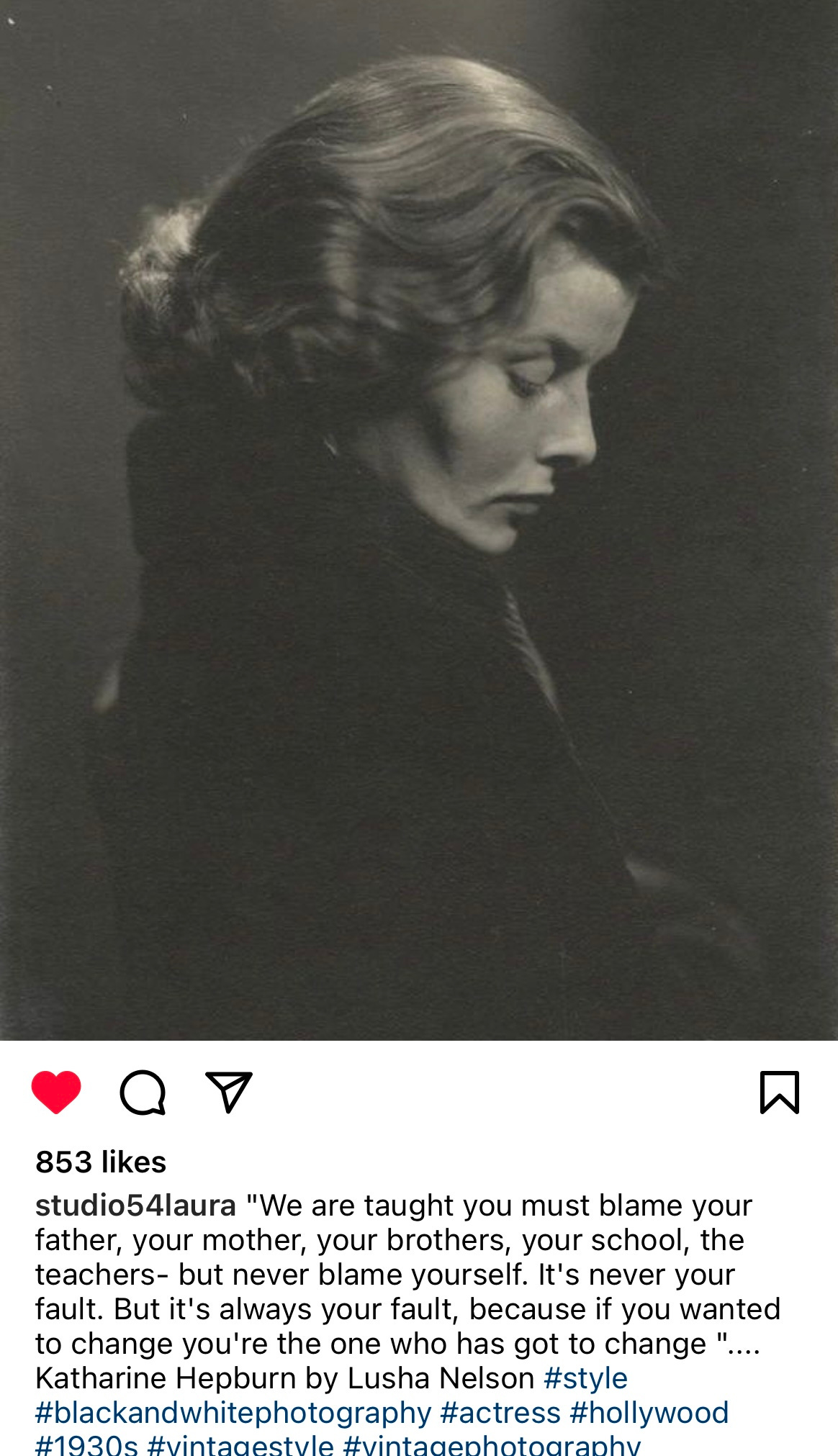
Yet in these thoughts myself almost despising,” haply I ran across this quote from my idol Katharine Hepburn via Instagram. She’s absolutely right—the only one who has to change in the above scenarios is I. Yet how, I wonder. And to what end?
Love or something like it, vamp 2-3-4,

Miss O’

Desert[ed] Solitaire

Miss O’ in New Jersey ca. 2012; photo by George Lightcap

Yesterday evening I emailed short notes to two of my dearest friends to 1) apologize for not writing much, as one does; and 2) to ask after their life events. (Not to keep you in the dark: one set of spouses, in their eighties, has had loads of health issues this year; the other set of spouses, hovering around age seventy, just sold their longtime California home and closed this week on another, even drier, California home, one that is smaller, one-story, much less land to tend, and in walking distance to simple amenities, like a grocery store.)

I expressed to both halves of these respective spousal sets that I have felt, for want of a better word, deserted. Is that the word I want? I feel deserted as at a railway station, as if I’m supposed to be headed somewhere and there are no trains, or as if someone has forgotten to pick me up after a long journey; deserted by things as disparate as companionship, comradeship, an artistic muse, a sense of mission, original ideas, and the national shared practice of democracy. That’s quite a list. 

When I wrote this to my friend Anna, she suggested I write a short blog post on the subject of desertion, and that felt exactly right. 

­­­­­­­­­Other Desert[ed] Places

First of all, I feel deserted by the practice of writing letters. Just so, long and deep conversations have deserted me. Other than Tom and Anna (my friends noted above), everyone else I’ve been in regular contact with for years tends to speak in memes and emojis, maybe links to articles at most. I respond in kind, mirroring what I receive. I know that many people are pressed for time in general and have dozens of people with whom they are in communication, whether friends or family or work colleagues. I never want to assume I should be somehow special. (Many of us have felt deserted by even our closest friends once they married, had kids, and made new parent friends.)

“Didn’t you see my post?” Deep connection has been supplanted by observational strings, er, threads, on Facebook. Several friends noted that it’s just easier to share their lives all at once rather than in individual letters to, say, me. In my own posting life, general observations shifted from “life in New York” to “politics all the time” when 1) Humans of New York started up, doing what I did far better and more deeply than I was, and with pictures; and 2) I saw the coming of a deep fascism with the election of the black president. (Big Tell for me: At President Obama’s first State of the Union Address, Justice Samuel Alito, who was in view of the camera, on several points about threats to our democracy, shook his head and said, “That’s not true.” I’d never seen a partisan justice at such a speech. Related: then-Speaker John Boehner (R-OH) wouldn’t look at the president, saying in an interview, “I can’t even look at him.”) All that open racism shocked me. Racism was, truly, the only explanation. I had to go on the offensive, deepen my understanding of racism, post like hell. Right?

In 2012, I voted for Obama’s re-election, Mitch McConnell (R-KY) became Senate Majority Leader, and a month later I released by e-book compilation of social media observations, Easier to Live Here: Miss O’ in New York City.

Now what? The nation was growing in chaos, and my sense of joy at living in New York began deserting me. This was 2013. My playwright’s lab disbanded; my first professional work project as a staff member at my work went to press and I felt sort of “done” with that job after seven years but couldn’t afford to leave; I was assigned to Grand Jury Duty at Kew Gardens in Queens for the entire month of September (with the disheartening revelation that Miss O’ may well have been the smartest person in the room, and that shouldn’t ever be the case), and that same month I began a deep but doomed love affair that would consume my heart for the next nine years, until learning, belatedly after a final breakup, of his death. (One of many blessings of this dear but complicated man was that he was not on social media.)

Desert[ed] Depths

The joy of knowing others doesn’t really come about in 140-character or 280-character posts, memes, emojis, GIFs. All these little sparkly things are fine, I guess, once you have a long-standing relationship of some kind—all good friendships develop their own shorthand, and in that context these digital digeridoos seem to me to be the equivalent of my friend Cindy’s old habit of looking at me, dropping an eyelid, and miming a cigarette to the lips when someone was about to pontificate or otherwise be an asshole. Without a word spoken, I would double over with laughter. I often act out the same gesture as a touchstone. A good meme can do that, too, and it’s funnier when you know the sender from your heart; but if I’m honest, it’s empty when that’s all there is. 

Second of all, I feel deserted by stillness. This morning, for example, I woke before dawn to find the all-night party music from somewhere was still on in full force. The school playground next door now has LED stadium lights that are blinding our complex in the name of “security.” I can’t seem to find calm. (Tell it to Ukraine. See what I mean?)

just a mass of contractions

I miss a mind quiet enough to read longform New Yorker articles in one sitting. I miss a body quiet enough to sit still and play a new album all the way through, listening to every song. Then playing it again, this time reading lyrics and liner notes and credits. Then playing it through a third time. Vinyl was even better because you could play the A-side three times, and then the B-side three times, and then listen to the whole thing once through. My friend Lynda Crawford, a playwright, wrote on Facebook that she missed listening to records the way we used to—one friend would buy the record, and everyone would come over and sit on the floor and we’d play it, and talk about it. I remember doing that with a 45 RPM of Helen Reddy’s hit “Think I’ll Write a Song” on the A-side, and then playing “Angie Baby” on the B-side, and my mom, Lynne, coming upstairs and saying to me and my friend Peggy, “Who is that? Is that still Helen Reddy? Now that is a good song.” She was right. But we all had to hear the song three times.

Now, I hear you saying, “But Miss O’, you can still do those things.” (Still. Hmmmm.) Yes, I can, in theory. But I have Twitter to scroll. I might miss something. I have Facebook to check. What if a “friend” liked my post? What if no one liked it? (Should I edit it?) What if someone died and I didn’t realize it? What if what if what if what if what if what fucking IF. FOMO. (I’ve had to look that acronym up I think each time I’ve seen it in New York Magazine, which feels less and less relevant each issue. The best one in the past few years was an issue dedicated to Jerry Saltz and his quest to be a great artist. More of THAT.) Where was I?

The truth in all this is that I am deeply sick of feeling deserted by…something…somehting I cannot seem to touch with my soul, my heart.  

Desert[ed] Hearts

Friends have lost family in the past two years. Last year, a poet friend lost his beloved wife to a stroke; two weeks ago a dear neighbor lost his brother suddenly to a heart attack; this week, another friend lost his beloved wife to lung cancer. Part of this is, we are all aging, my friends and neighbors and I. But the loss isn’t less. The feeling of desertion stings.

President Biden, who lost a son to brain cancer seven years ago, gave a speech Thursday night—possibly one of those historically great ones—defending democracy against fascism, and the three major networks and PBS deserted him and the American people by refusing to air it. (The next day, as if to reinforce this sense of desertion, newspapers seemed to support the wounded fascist MAGAs over the 70% of Americans who want to preserve the democratic union.)

And when all this happens, all this sudden and deep emotion, I seem to shut down. I don’t know how to help anyone, to help the country. I feel deserted by my mind.

In her deep empathy, Anna said in response to my feelings of desertion and perpetual waiting, “Seems like a lot of us are waiting for an unknown something. I wonder if we should just act as if what we’re waiting for is going to arrive or has arrived.” 

That’s what President Biden has chosen to do—to act as if the People want democracy, are willing to vote to preserve it—and meanwhile, he is just legislating like hell, bringing down inflation, addressing global warming, championing women, the whole bit, like tomorrow is not only coming but is already here.

So, to paraphrase Helen Reddy, I thought I’d write this blog, one in which I act as if what I was waiting for was the impetus to write a blog. After all, the worst thing we can do is nothing.

Take a memo. 

A handy meme from johnpavlovitz.com

It’s Only My Hair

For as long as I can remember, I’ve had an innate sense of justice and fairness. It’s obnoxious. I think the feminist mantra, “The personal is political,” got into my consciousness around the time it was coined, ca. 1969. I was five years old, living in a new-ish suburb of D.C., a working class kid with Depression-era parents who were moving into the middle class thanks to unions. I think my sense of justice came about because, almost from the time it came on TV, I was watching Rowan and Martin’s Laugh-In. Even the slapstick taught me that life is unfair, often cruel, but can be redeemed with a  hearty laugh at yourself. I also watched All in the Family from its first airing in 1971, when I was seven. And I even watched the Maude abortion episode in its original two-part airing in 1972 when I was 8. (My mom, Lynne, explained abortion to me, as simply as possible, and while I may be sketchy on her wording, I know it came down to a hard decision that a woman who is pregnant has to make for herself.) The Vietnam War was on television for the first ten years of my life (The year I was born, 1964, was the last year of the Baby Boom), and so were hippies, sit-ins, The Smothers Brothers, and Nixon. Public Service Announcements affected me deeply, however righteous or even absurd, as did School House Rock, where I learned to sing the Preamble of the U.S. Constitution in true folk singer tradition—with repetition, so we could all sing along. The phrase “establish justice” always stood out for me. I don’t know why.

It was in first grade that I first remember putting my hands on my hips and yelling at a peer, a white boy, to tell him to behave. I don’t know where I got that voice, exactly, from inside myself, because I was a rather shy child and very nice. But when I saw things I thought were wrong, I couldn’t stop myself from voicing my outrage. Naturally, my friends loved it. It didn’t embarrass them at all. And all those shows I watched? The ones that none of my friends were allowed to watch? Well, it was my job to retell them as stories. Surely this made me popular with their parents.

When I was in 7th grade, a teacher I adored didn’t like me much, and I chalk it up to that voice of mine. The great leveler—the event that should have knocked me and my voice down a peg or ten—came in the form of a haircut my mom gave me. My mom, Lynne, really had no business with a pair of scissors in her hand (see attending photo, pre-cut story), but we just didn’t have the money for haircuts. At this time, my mom hated my wavy long hair, and thought—oh, how wrongly she believed—that cutting it short would remove the curls. Instead I turned into Orphan Annie. It was all Miss C., the teacher, could do not to snort. And in that moment, far from losing all confidence, I lost instead all vanity, which is just what any 7th grade girl needs to do if she is to forge an independent life. Braces, freckles, clown hair: “I look surprising, and I know it,” my flashing eyes said. And then I laughed. I think it was then I settled into myself, that essence. It turned me into a teacher.

Who are you essentially? When did you know it? How have you used it? Let me hear a story from you.