This Is the Real Story

Featured on my kitchen wall is a framed series of five photos, one under the other, that depict me and two other women rolling down a green grassy hill. My friend, Patty, a professional framer, matted and framed this series for me many years ago, though why I wanted it, no one understood. I knew why, so really that’s all that mattered. And though it’s framed nicely, each time I look at it, I get stuck at the last two pictures. To me they are in the wrong order. The second to last one in the frame shows me and Roller No. 2 sitting up, my fists raised in triumph, my legs up, ready to do it again. The last one in the frame shows the Rollers 1, 2, and 3, passed out blissfully on the grass. The trouble is, the action happened in reverse of the order: We were passed out blissfully, and then we popped up and went back for one more roll. However, as Patty pointed out, anyone looking at the series would be aesthetically unsatisfied with that—she insisted that the three of us collapsed at the bottom of the hill was the right feeling of “this is the end.” I didn’t agree, but she was a terrific artist and very sure, and I just wanted to hold the memory, so I let her tell the story her way. It’s a story that, if you weren’t there, maybe made more sense.

Here is the real story: They were middle aged, these three women, and I had just turned 30, and we were teachers in graduate school for the summer. Three of us were housed in a large mansion-style dorm atop a big hill, and I had remarked on the day of our arrival, “This is a perfect hill for rolling.” I was wistful. The two women on my floor whom I mentioned up there, Anna (the photographer) and Suzanne (Roller No. 3), had no idea what I was talking about. Anna had grown up in California where there were no green rolling hills, and the same was true for Suzanne, whose landscape was Midwestern, up northern way. That very same evening—our first of the summer—Annie from Mississippi came up to the house on the hill, and from upstairs I heard her say, “This is a perfect hill for rolling!”

I flew through the door to the upper porch, where my room was set, leaned over the balustrade, and called, “Annie! Will you roll with me?”

Anna, from across the hall, called, “Wait for me!” and came out of her room with her camera.

Suzanne, next door, said, “You mean I get to SEE this?”

I said, “You have to DO it,” and we three raced down the stairs with that child-like rush of feelingas if, if you don’t hurry, your chance will be gone forever—and outside, where Annie and I taught Suzanne her options: either arms crossed over your chest, or arms outstretched over your head. We spread out. And…GO! Somehow in that flash of chaos, Anna had managed to capture, 1) me rolling alone; 2) a shot of Annie and Suzanne rolling; 3) all three of us from a crotch view, slightly blurred; 4) us three flopped on the ground, three pairs of jeans and shirts of pink (me), lavender (Annie) and purple tie-dye (Suzanne) all against that deep, luscious green; and 5) me bent in a V from my butt, arms and legs up, and Annie, sitting with arms back, her face in a smile, and we’re ready to go.

That is the real story, the real sequence, but because it doesn’t read as the usual narrative, or the most tightly constructed or aesthetically pleasing narrative, I’m the only one who would look at the series and be dissatisfied. Or would I? In truth, I don’t think anyone has really ever looked at it outside of me, because it’s not exactly a universal story, or even a “lovely” portrait of any person, or of nature.

So what does it mean to tell a story “the real” way? And does it even matter?

When I was in college studying to be a teacher—which is as antithetical as it sounds, for as every professor of “education” will acknowledge, nothing they are teaching will be useful for at least three years into teaching, when experience would make it make sense; and my own view is that what they should be teaching is how to write a bathroom pass and not lose your train of thought in an instructional moment—I was fortunate, and I mean beyond lucky, to have two guest professors when I took Psychology of Education I and II in summer school. I’ll call them Ms. Lettuce and Ms. Lovage (with apologies to Terrance McNally). Both teachers were invaluable to me, but Mrs. Lettuce was the person who got me thinking about the “real” story.

As a first-year teacher in a coal-mining town in West Virginia—a town and culture she’d never before encountered—and on her first day teaching first grade, Miss Lettuce decided to start off by reading to her students “The Story of the Three Little Pigs.” When she got to the first instance where the wolf “huffed and he puffed and blew the house down”—the house of straw—a little boy in the front row said, “That son of a bitch.”

Mrs. Lettuce turned to the class, most of us either gasping or giggling, and asked, “What do you think I should have done?”

You know what’s great about her question? THIS moment is exactly the thing that university departments of education never teach you, the kind of thing that will happen to every new teacher in every new school on every single new first day of school in America, now and then and forever: the kind of moment that makes you quit by the end of the first year, after day after day of these moments, with no story to guide you.

Several of us teachers-in-potential raised our little hands, either pontificating on why he needed a stern punishment and a meeting with his parents, or gently suggesting that the teacher rephrase the remark to something more appropriate and speak to him in private later. Mrs. Lettuce said, “Why didn’t any of you ask how the other children reacted? Did you assume they laughed or gasped, too?” And it made me think: Why don’t we ever stop to ask something as basic as that, about context, to step back and look at the whole picture? She continued, “When that little boy said, ‘That son of a bitch,’ all the other children nodded,” and here she mimicked their very solemn nods. “Now what do I do?” No one in my class said anything. “Because you see what’s going on here, don’t you?” she asked. And we didn’t. “If he said that, and the children agreed and accepted it, that tells me that everyone in this community, in this culture, talks that way, that all their parents talk that way. I saw immediately that if I corrected him, I’d be correcting all these people I didn’t know. And I am the outsider, remember.”

So what did she do?

“I said, ‘Would you excuse me for a moment?’ and I went out into the hall, closed the door, and laughed. When I got myself together, I went back in, and I said, ‘I’m sorry I had to step out,’ and finished reading the story. That’s all.”

What Mrs. Lettuce realized was that the story of this culture was not her story, and so not her story to alter. It was her story to learn. And she passed that story onto us. (And this story helped me stay for three years in an alien rural school system where, in the view of many, I had no business to be.)

And as to the reaction that the child back there expressed about the wolf, “That son of a bitch,” was he wrong to feel that way? In fact, children have an innate sense of morality. Vivian Paley, a Chicago teacher and great researcher of children, relates in one of her books (I don’t remember which, and I think it was Paley, so I hope I’m not misremembering) a similar experience of reading “The Three Little Pigs” to four-year-olds.

First, let’s recall the original Grimm’s fairytale: three pig brothers have to build homes, and the first pig builds with straw, the second with sticks, and the third with bricks. The terrible wolf blows down the first two houses, and eats the pigs, but he cannot destroy the house of bricks. That last pig lives. The wolf goes away. The end. The lesson: You need to work hard and take the time to build a sturdy house to protect yourself, or you will DIE.

But that isn’t the story most people in America know, and here is what Paley discovered by telling the version of the story in which no pigs die. She read the children what I’d call the Disney-fied version, where the brothers sing, “Who’s afraid of the Big Bad Wolf,” and when the wolf comes, the first brother runs to the house of sticks, and when the wolf comes again, the two brothers run to the house of bricks, and then the three brothers trick the wolf and boil him in a pot. Disney, who really wasn’t one to shy away from violence—I mean, who can forget the death of Bambi’s mother?—for some reason didn’t kill off the pigs. Without those deaths, what is the lesson? Go ahead and be a lazyass pig—your brother will save you. That is not a good lesson.

And Paley’s young students felt that. When Paley finished reading, the children looked dissatisfied. One child asked, a little fearfully, “Is that the real story?” Other children asked the same question. They’d heard another one, perhaps, but somehow this one just didn’t feel right. And Paley told them they were right, that there was another version. And they looked afraid, but they wanted to hear it; and she told them, and they cried when the first two pigs were eaten by the wolf, but they were satisfied with the story, because innately they knew that this was life, that this lesson mattered. They wanted to hear the real story.

I think that inside of these children, of all children, must be a hundred thousand years of genetic memory. No one taught those four-year-olds about narrative structure, or ethics, or what happens in “real life,” and yet instinctively they knew the real story, what the true story ought to be.

I think American adults in general have lost their way when it comes to our real story, our national story, and the reasons for this go back to the Puritans, as everything does, with a view of life as something to be dictated by religious patriarchy rather than lived and experienced deeply, connected to the natural world and our own intuitive, honest natures. And so, as there must be one narrative, one story, to publish in the history books (for humans are still in need of a story, whatever else happens), we pick and choose the pieces we want to include in our collective story, and by “we” I mean white men, the majority culture, in power. I don’t write this in acrimony. That is part of our real story.

But here is the shame: The American story is not just Founding Fathers with capital F’s, the colonists against the British; or the Wild West, with capital W’s, with wars of cowboys against Indians; or the Civil War—which in much of the white South is known still today as The War of Northern Aggression—or even only wars. These stories, too often, have been reduced, in the popular imagination (until most recently and blessedly, Hamilton), to vague tales about ragged coats and red coats, white hats and black hats, blue and grey: they’ve become bloodless, artificial. What gets lost in these acceptable history book narratives is the deep story of the People: the thrill of the exploration of the oceans and discovery of new worlds and also the savage destruction of native people and cultures and lands; the astonishing bravery and also the emotional brutality of the Puritans; the deep Christian convictions of early settlers and also the hypocrites who took advantage of those convictions for personal gain; the astonishing growth of agriculture to feed the world and also the enslavement of Africans to make that growth possible; the growth of industry and also the exploitation of immigrants and the earth to make that growth possible; westward expansion and also the utter destruction of the native way of life; and woven through all of this, the story of women taking part in and helping shape all of these stories, shoulder to shoulder with men, with nearly none of that story recorded. This story of America is one thing AND the other. The story is huge and vast and messy and complicated and fraught. It’s a continuing story.

If four-year-old American children aren’t afraid to hear “the real story,” why are the majority of grown American adults afraid to hear it? Why are certain hugely powerful media companies run by white men, for example, so afraid of “the real story,” the true story, of America that they feel they must create their own narratives, narratives in which there must be good guys and bad guys, and the only possible villains can be immigrants, Muslims, blacks, or women, and the only good is the continuation and protection of white male greed using repression and guns? All over the news, this is too often the only story, or the story that a few others try desperately to fight against. But it isn’t the real story, is it? We know that it’s not. What is the real story?

This sort of story manipulation doesn’t belong only to America, and it surely can’t be laid on Disney’s doorstep, or even at the threshold of the corporate headquarters of Fox News. This deliberate, inorganic story manipulation has only been possible in the last few thousand years out of many millennia, when because of agriculture and surplus, nomads began settling into villages, where, out of laziness, really, a few charismatic men began duping and robbing the workers and families of these villages, amassing wealth, and then hiring the men they’d robbed to make weapons and form armies, so they, the overlords, could take even more, scapegoating races of people and creating the massive military industrial complex—models of this dating back to the building of vast flotillas of all manner of ships, the breeding of horses for riding, and the forging of iron weaponry, all made for the sole purpose of carrying out large-scale warfare, among the men of Egypt and Greece and Rome; among Vikings and Saxons and the Angles and Normans; among tribes everywhere, really, when one goes deep into the stories.

That’s the real story of the People of Earth.

And the only way to change that story—because it simply isn’t sustainable, resources being what they are—is to shift the power dynamic, to decide, as a People, that the sociopathic-lazy man-warmonger narrative is not only wrong, it’s silly. We could be having so much real fun when we aren’t facing real, naturally occurring dangers. More to the point, we are, right now, for real, a People in Crisis, a climate crisis, brought on by global warming born of industrial ignorance and, of course, greed. You can trace most any problem to the grasping greed of a few bad men. Wouldn’t it be amazing if we turned our story—focused all our warrior energy—into working to salvage and heal and restore our Earth?

Here is the story:

Once there were three women, all teachers, two middle-aged and one just turned 30. The young woman, from the eastern plain, saw a deeply gray, dirty world that cried out to be cleaned, to be respected, to be enjoyed, and to be loved. She shared her vision with the woman from the western plain and the woman from the northern plain, who agreed, because they had been thinking the same thing. And from the southern plain came another woman teacher, middle-aged, who cried out, “This is a great world, and it needs cleaning!” And the youngest woman called out, “Will you clean it with me, Annie?” And so it was. Western Anna grabbed her camera, to tell the story of the Great Cleaning, and Northern Suzanne, who hadn’t cleaned before and wanted to learn, joined the women of the East and South, and together from all four directions the women grabbed their brooms and flew out into the world to clean it up and make it live, and to tell the story.

Here the storyteller shows the children the pictures that Anna had taken. The children notice that the person who framed the photos of the women in this story showed them flying out to clean the world, one by one, and the last photo is of them lying down, exhausted and finished with the work.

And here a child asks, a little fearfully, “Is that the real story?”

And here the storyteller pauses, and sees that she has to tell the truth.

“No. There is another version. Do you see that second to last picture? The one where they seem to be getting up to do it again? That comes last. You see, the work never ends. The story doesn’t end.”

And though the children were afraid at hearing this, and even cried, still they were satisfied. This was the real story.

IMG_1535.jpg
Photos by Anna Citrino; framing by Wilkins Myrick Frames and Fine Art; wall located in Queens, NY.


Re: Public

“Eighty percent of life is showing up.”
~ Woody Allen

IMG_9472
“Show Up: Collage by Miss O’, June 2017

Public:
From the Middle English publique, from Anglo-French, from Latin publicus; akin to  Latin populus people

First Known Use: 14th century

(Source: Merriam-Webster online)

Back when we the aspiring wrote our first serious essays for public view in high school, one of our classmates would have the novel idea (novel for a 15-year-old) of opening the essay with a dictionary definition of a key word, such as “stream” or “consciousness,” say, to start off the proceedings. Other eager writers, deeply impressed, would then copy this technique, and at some point during the year, after reading dozens of such openings, your teacher would write in red on your essay, “You might try another approach.” Deflated, for you were really excited to try out your brilliant classmate’s technique for yourself, you nonetheless pushed yourself to find a unique way into the next essay. The same happens when we in the theater direct classic plays: We can’t repeat the same old formulas when approaching a classic, because what was old needs to feel new again: Artists look at a work by, say, Shakespeare, and ask themselves, Why this play? Why now? What could we do to bring it to life in the modern age, make it contemporary and meaningful to today’s theater-goer? Sometimes it works, this novel approach, and sometimes not so much, but one of the best things about art, even if done without easy success, and maybe especially then, is that it gets us, the public, talking about it.

So with all that in mind, and given the current controversy over the Public Theater’s production of The Tragedy of Julius Caesar in Shakespeare in the Park in New York City (and can I get a “Hail, Caesar”?), it seems a definition is in order. According to the Merriam-Webster Dictionary online, here are the definitions of public:

Definition of public https://www.merriam-webster.com/dictionary/public

  1. 1a:  exposed to general view :  open b :  well-known,  prominent c :  perceptible,  material
  2. 2a:  of, relating to, or affecting all the people or the whole area of a nation or state public law b :  of or relating to a government c :  of, relating to, or being in the service of the community or nation
  3. 3a:  of or relating to people in general :  universal b :  general,  popular
  4. 4: of or relating to business or community interests as opposed to private affairs :  social
  5. 5: devoted to the general or national welfare :  humanitarian
  6. 6a:  accessible to or shared by all members of the community b :  capitalized in shares that can be freely traded on the open market —often used with go
  7. 7: supported by public funds and private contributions rather than by income from commercials public radio public television

Your Miss O’ here hasn’t seen the now internationally famous production (free and open to the public (see definition 3a) in Central Park, closing today as they prepare their next offering (A Midsummer Night’s Dream, with Melania as Titania; I kid! Ahem), but I did teach the play itself for all of my 15 years in public (see definitions 2a, 3a, 5, and 6a above) high schools, as an English teacher. The play has been taught nationally since the early 20th century, I learned, as a replacement for what used to be called Rhetoric, when public speaking (see definition 3a above) began disappearing from the school curriculum. Julius Caesar the play is, as was the man himself, fabulously political, which is often unwelcome in America lately because too many Citizens (or Plebians, in Caesar) aren’t terribly educated on the whole about civics (a Greek and Roman idea with a Latin root in the word). Schools, as we know, are competing with lots of stimuli from the public arena (see definition 1a above), and teachers more often than not are having “to fight to teach,” as Miss O’s colleague of many years, Mrs. Little, was often heard to say in the years before she retired.

So what is a public? What is a republic? And what do they have to do with a theater in New York City called The Public Theater? I read yesterday of all these protests attending the Public’s production, protests carried out by a public consisting of people who have probably not heard of the play outside of a vague memory of suffering through Mrs. Ayers’s triple-matching test one semester of their sophomore year of high school (I mean, what the hell?). Doubtless the protesters of the Public had never read the play with anything like understanding, let alone seen a live production, or even sat through the entire movie with Marlon Brando in the pivotal role of Marc Antony.

What they are missing—and what anyone up in arms (an idiom which was once quite literally about raising ones weapons) about this event is missing—is knowledge, both of the subject matter and the play. (One could say the same about most any public protest, for one should always know deeply the why of any protest.) It’s easy enough to Google both the man or the play in Wikipedia (and anyone reading this blog won’t need to, more than likely, which is the futility of writing blogs like this), but chances are that even still, most Americans probably know more lines from it than they realize:

Friends, Romans, Countrymen, lend me your ears…

…let slip the dogs of war…

Though last, not least in love… (“last but not least”)

Those might surprise you—these everyday things. Here are others, seen online:

Beware the ides of March.
(1.2.23), Soothsayer

Et tu, Brute? Then fall, Caesar!
(3.1.77), Cæsar

Friends, Romans, countrymen, lend me your ears;
I come to bury Cæsar, not to praise him.
The evil that men do lives after them;
The good is oft interred with their bones;
So let it be with Caesar.
(3.2.79-83), Antony

It was Greek to me.
(1.2.289), Casca

Cowards die many times before their deaths;
The valiant never taste of death but once.
(2.2.34), Cæsar

This was the noblest Roman of them all.
(5.5.75), Antony

Men at some time are masters of their fates:
The fault, dear Brutus, is not in our stars
But in ourselves, that we are underlings.
(1.2.146-8), Cassius

This was the most unkindest cut of all.
(3.2.193), Antony

Let’s carve him as a dish fit for the gods. (“a dish fit for a king”)
(2.1.173), Brutus

Not that I loved Cæsar less, but that I loved Rome more.
(3.2.23), Brutus

What Julius Caesar is, though, beyond the quotes, is a fascinating study in the greed for power desired by a few men who would lay waste to the land, their institutions, and the people they would lead in order to attain more of it. It’s a study, too, in the use of language, of rhetoric, to not only persuade but also hoodwink a crowd with conspiracy theory, getting the crowd to do the looting, killing, and army work in order to feed the hunger of one man’s desire for power. In other words, it’s an instructive play, and it’s a hard play, and its themes are and remain universal across civilized societies everywhere. And it took me years to understand it and to love it. That is Shakespeare for you. That is life for you.

The Public and the Republic

Should you care to, there’s a solid Wikipedia article on the meaning of republic, and it’s worth a look at the history. At the time the play is set, and in real life, Julius Caesar was the head of the Roman Republic, which republic was an exercise in representative government that carries over to our American Democratic Republic today. At the time Shakespeare’s play begins, Caesar was about to be crowned emperor by the people, and the concern of the play is, and remains, our own concern today: Can we have representative government of the people with a king in charge, however idolized by the general populus? And is assassination (a word that first appears in print in Shakespeare) of the man who would be king ever the right choice? (Hint: No.) And why are crowds so easily manipulated and so goddamned fickle? The rise of Marc Antony is especially chilling. If you read nothing else, read Act III of the play: The assassination, the aftermath—ring leader (and yet noble) Brutus’s hasty act and unrehearsed speech, Antony’s vengeful use of that speech in his own rhetoric to turn the crowd to “mutiny”; and finally, the shocking turn of the grieving Antony into the gleeful victor as the crowds tear away on a killing spree: “Mischief thou art afoot. Take thou what course thou wilt.” In Act IV, he has his own nephew killed. And we and the people learn the hard way: Great a speaker as he is, devoted to Caesar as he is, Antony is really only loyal to Antony.

Coming Up Trumps

Yet another Shakespeare play resembles the present age of American politics: it’s Richard III, only with a president who is infinitely less intelligent if no less mentally unstable than Richard. But what the two have in common is a desperate need for power, accolades, and above all loyalty. Watch Al Pacino’s wonderful documentary and filmed version of scenes from the play, Looking for Richard, and you’ll see what I mean. And another Shakespeare play that comes to mind, in a painfully diminished form, is King Lear, where the old king divides his empire among his three children, demanding from each supplication and eternal devotion. And we all know how that turned out. Or we should—and it’s why education and the arts matter, matter, matter. Goddammit anyway. Because if you’d just read Shakespeare, you’d see that not only have we seen all this before, we saw it in language so far elevated above the National Tweet it makes your head do a Spicer spin. And yet Shakespeare might make some people feel, you know, stupid, or put down, because anyone can understand a tweet. And isn’t that all we need?

Going Public

 Julius Caesar can be read as a warning parable to those who try to fight for democracy by undemocratic means. 
To fight the tyrant does not mean imitating him.” – Oskar Eustis

IMG_8705
Photo by Miss O’ from the Staten Island Ferry, June 2017

The Public Theater (see definitions 1-7 above) is a terrific institution (https://www.publictheater.org), if hit-or-miss in terms of quality, so that the same theater that gives you Hamilton and Fun Home also gives you David Byrne’s (“not ready for prime time at ALL” according to friends) Joan of Arc and, according to some reviews, this production of Julius Caesar (Read Oskar Eustis’s statement here: https://www.publictheater.org/Julius-Caesar/). As to hit-or-miss: Who cares? Life is hit-or-miss (just ask our president and his two ex-wives, and probably his current wife, to say nothing of the business owners he screwed over), and unlike those folks who tell you “life is not a dress rehearsal,” Miss O’ would argue that life is ever that. It’s an experiment, and it requires engagement, adjustments, rethinking, and, sometimes, new costumes to keep up with the fashions of the times. It’s also worth remembering that, as Oscar Wilde said (pardon the cliché), “Fashion is a thing so hideous we are forced to change it every six months.” And most politicians, too, can and do become hideous—hence the need for term limits.

Speaking of term limits, most plays have a limited, and often terminal, run. Modern productions reinvent classic plays for a new age, and they, too, have a limited run. And this president, provided we don’t have an assassination attempt, a military coup, or war to end all wars, will also have a limited run. He’ll be sent packing, or will leave of his own accord to start up a TV network, or die of heart failure in office, or walk clumsily out after Inauguration in eight years, red necktie beating his face, as he heads to his gold-plated jet for rich living in his Tower till the end of his days. It’s a crapshoot, and yet we have to keep playing craps.

How many ages hence
Shall this our lofty scene be acted over
In states unborn and accents yet unknown?

~ Cassius to Brutus, Act III, scene i, Julius Caesar
Translation: Karma is a BITCH.

The personal is political, as the feminists say, and the political becomes personal, in the best and worst ways, depending on the will of a fickle public. I took a trip to Ireland in April and noticed that there really was a pub, or public house, on every corner, and it’s not hard to see why. We could use a drink. The Irish know that as well as anyone.

IMG_9180
At Aggie’s Pub in Killea, Dunmore East, Ireland.

And a TRIP. Travel, for goodness sake. Travel. Get out of yourself. I can’t tell you how much better I felt about life, both during and after Ireland. Show up to life, sure, and then pay attention. And the more we, the people, can venture out and gather in public and LISTEN as well as protest, the better chance we’ll have to weather this latest political tempest. Ask Ireland about The Troubles, for crying out loud. This is nothing, I tell ya. And still we have to DO something about ours. So do that, and in a democratic way.


Sending love to all,

Miss O’

IMG_8948
The Ring of Kerry, view, Ireland. It took the Irish 400 years to gain their independence from Britain, the empire that captured and subjugated everything and everyone, except the little island next door. These are my kind of people.


A Wing and a Prayer

Spy Planes

Outside my street-level bedroom window just now, I heard a man’s flat voice, and then a woman sobbing deeply, suddenly.

“Oh my God, I’m so scared,” she cried. I looked out the window. Do I get involved?

She was sitting in the passenger seat of an open-doored SUV, her chestnut hair thick and wavy, her skin smooth and olive; the man next to her only seen from the back, and barely, bobbing his grey-curled head, was fiddling around with something in the backseat, the backseat door open and between them. Her body was limp, heavy, head hanging. He said something, twice, about “the baby.” She turned to look toward him, and sobbed again.

Her sobs came in a rich voice, velvety and agonized, past which I heard his relentless, flat, hard words speaking over her cries in monotone, unemotional and relentless, without comfort or attention to her pain. Her sobs only deepened.

This, thought I to myself, is the near-complete story of Woman in the World of Man.

img_8296
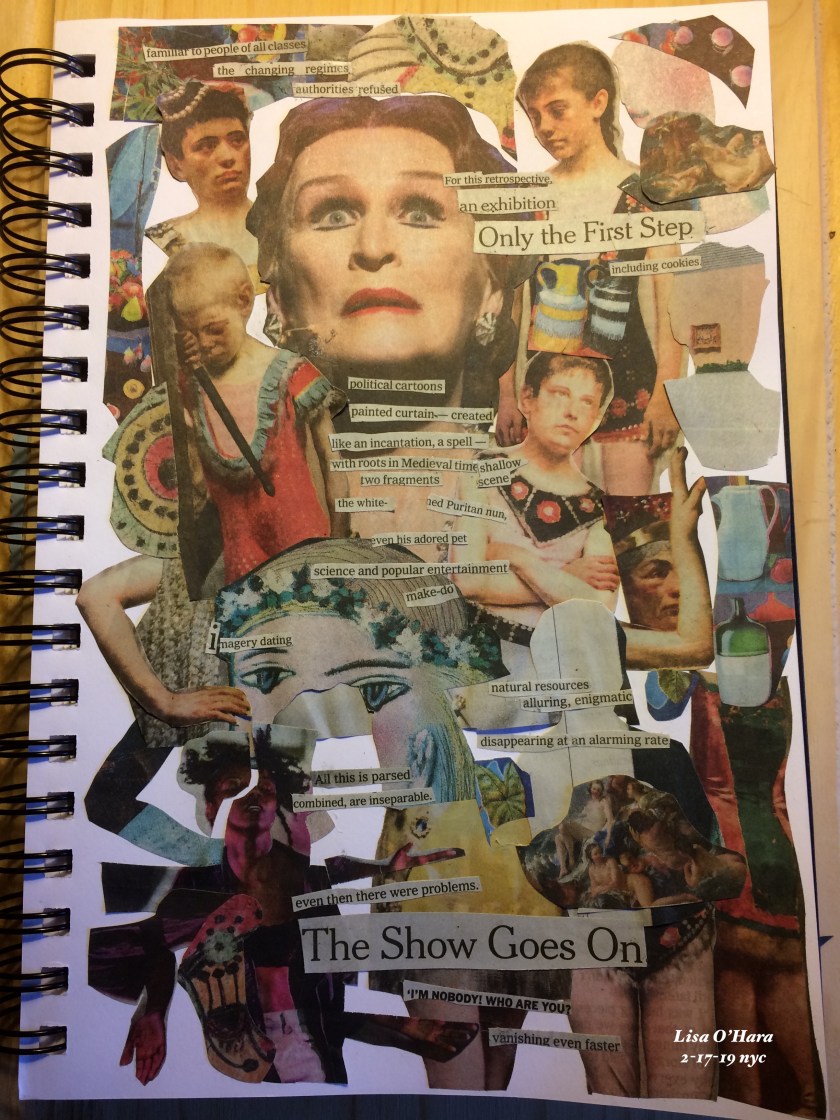
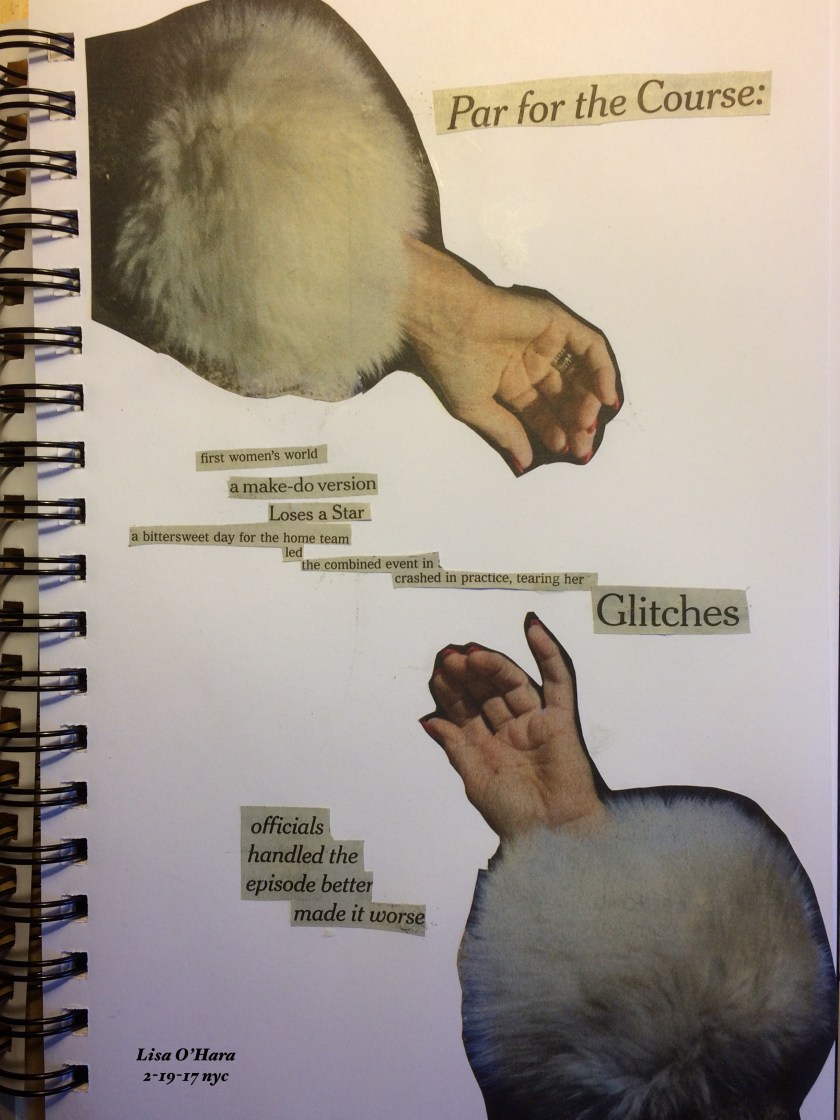
Collages in Progress, LO’H, NYC 2-18/19-17

“How the hell do I know why there were Nazis?
I don’t even know how the can opener works.”
~ Father of Woody Allen’s character Mickey Sacks, Hannah and Her Sisters

Family Trees

What makes women and men so different? An age old question.

Another age old question: What makes families so different? This sort of questioning is what happens when you reconnect to childhood memories on social media, and lately those connections have been made through politics almost exclusively.

Here’s yet a third age old question: What is the best way to be useful politically? Do you write a check, or do you throw your body at it?

I have several different memories of people around our neighborhood doing what was called “volunteering.” They led newspaper recycling drives, or, say, cleaned the litter from the corner acre lot with the wild stream and blackberry bushes where we kids played kickball and built forts and explored. I remember Mr. Scott from up the block stopping by our house one day during just such a clean-up effort, to ask for a jug of water, which my mom, Lynne, happily handed him—a glass container that had once held orange juice, a thing which people like my parents, who grew up during the Depression, saved for moments like this. Later, Mr. Scott stopped by to return it, with thanks. Because he grew up during the Depression, too.

As I brought the jug into the kitchen, which was a very short journey from the front door in our very small house, I asked my mom, “How come we never help with things like cleaning up or being on the PTA or doing newspaper drives?” And my mom regarded me through the blue haze of her ever-present Salem cigarette and said, “Honey, we don’t volunteer. We write checks.”

Knowing as I did how little money we had and how carefully my mom managed it, it seemed kind of crazy that we would “write checks,” but that’s what we did, five dollars here and there, when we had it. We carried old clothes and other items to the Salvation Army or the Good Will. But we didn’t get involved at the community level, not bodily. It just wasn’t us. I am still this way.


What the O’Haras did, though, was get to know new neighbors, person to person. White or black, poor or rich, a dozen kids from assorted fathers and mothers or a small traditional nuclear family, if you moved in within ten houses of us, we may not bring you a cake, exactly, but we waved from across the street. If we got a response, we—and I mean all of us, kids and parents, individually—would walk across the street and get to know you. We’d size you up, sure, while we told you the history of the house you were in. We welcomed you as one of our own, and this only stopped the first time you stole from us, and this happened often, and my mom would sit you down and explain to you, firmly but lovingly, that we could no longer trust you to be in our home, and she was deeply disappointed in you. “All you had to do was ask,” she’d remind you. And the door closed behind you forever. Though we still waved, asked how you were doing, and cared.

What the O’Haras also did, to borrow from poet Marge Piercy, was “dive into work head first.” Wherever we were—and I’m feeling a little Faulknerian narrating in the first person plural but it’s what I mean—and whoever you were, whether a stranger in the supermarket parking lot trying to put bags into your car, or a kid who dropped books in the hallway—we would, by instinct, reach out to help you. Many hands make light work. It’s no trouble. Glad to do it. Pay it forward. We do it with money, too. (My youngest brother, just last Christmas, bought a $25 gift card at Walmart after I’d checked out, and handed it to the harried-looking Hispanic woman behind us, laden with stuff, counting pennies. He simply said, “Merry Christmas,” and off we went.) It’s a way of being, is what I’m saying. When people ask us—and they do—why do you bother to help like that, we always ask, “How can you not?”

That said, as I said, we don’t volunteer to do community work. That’s where the Rachovs come in. The Rachov family (as I’ll call them) lived two streets over, five kids, one for every one of the O’Haras plus one, and we went to school with them all our lives, even into college. But while we knew them, and they were really nice, and Mrs. Rachov was easy to spot for her great height, her big smile, and her ever-present bandana covering her hair as she knocked on the door to collect newspapers for the annual drive, I remember them not being exactly approachable. As a family, they seemed sort of in love with each other, and we O’s were raised to be independent.

What got me thinking about them at all was that recently, by accident really, I reconnected with the oldest of the Rachov children on Facebook, a friend of a friend, a woman named Martina Benson. “I used to be Tina Rachov,” she wrote me. When I realized who she was, I admitted, “Your younger brother un-friended me a few years back.” In fact, that “friendship” with Kurt lasted about a week, his right-wing politics outraged by my crusade for voting rights (which outrage never ceases to amaze me in a democracy). Tina remarked, “Yeah, I have him blocked. And his oldest son. And my parents.” I wrote her what I remembered about her helpful family, and she said, sarcastically (as it turned out), “We were so warm and inclusive.” And it was then that I recalled that her mom’s ever-present smile was sort of dead-eyed when not directed toward her kids.

And that’s how all this got me thinking about the O’Haras, who, whatever our failings in terms of community involvement, always voted and always took in stray people who just didn’t know where to go. Until they stole from us, which they almost always did. The Rachovs, by contrast, gave to the community as a whole, but were not only insular but it turns out repelled by the individual people who made up their community. Growing up, Tina was always described by her brother Kurt as “the crazy one,” and he’d shake his head and smile sadly as we passed her walking alone down the road. Now I realize that however much the Rachovs modeled civic duty, it was crazy Tina, the oldest and a girl, who had an actual heart as well as awareness of and real kindness toward those who were different from her. Go know.

And yet, looking at what the O’s and R’s both accomplished, don’t we need both sorts of families, however crazy-making?

img_8304

Right Wing Meets Left Wing

Don’t we need both a right wing and a left wing if a bird is to fly?

Politically speaking, what makes the right wing and the left wing so different? Shouldn’t we want the same things, to fly in the same direction, toward food, warmth, safety?

What I really wanted to write about today was the three beliefs/qualities/ethos that separate the right wing from the left wing on this big-ass bird we call The Republic. It’s pretty basic.

  1. Private vs. Public

a. The Right Wing: The right wing believes in legislating private morality, such as sexuality, reproductive rights, and the freedom to act on one’s personal biases based on race and sex, for example; and leaving the policing of public works and rights, such as air and water quality, land use, food supplies, and basic rights of citizenship, up to private corporate entities. The right believes that limited, exclusive, and private access to personal wealth is the only path to true freedom, and that there is no such thing as a social contract. Only by blocking social progress, limiting access to public help, and inhibiting the personal freedom of the lowest of society can man be truly free, and very rich.

b. The Left Wing: The left wing believes in legislating policies over things we all share, such as air, water, health care, and food supplies, as well as basic rights of citizenship and equality that allow us to have the freedom to pursue our happiness and not hold back the happiness of others. The left above all wants to make sure we all have equal access to all public works, including things as seemingly disparate as clean water and the arts. Public is public, and the left believes it is protecting the social contract that keeps all of us not only functioning but also aspiring to greater heights. The left wants everyone to feel they are invested in the society, money be damned.

   2. The Myth of the Level Playing Field vs. Sharing the Wealth

a. The Right Wing: The right knows that it’s a level playing field, that all humans are born with the same rights, wealth, opportunities, and living situations, and that it’s up to each of us to make the most of what God has given us. Someone on the right will never, ever be okay with lowering his or her standard of living even a little tiny bit (unless it’s by spontaneous personal giving) in order to help the less fortunate, because there is no such thing. Therefore, whatever God sees fit to deliver to you—whether it’s extreme poverty or huge wealth, disasters or benefits of weather or health, an abusive home or nurturing environment—it’s all one and the same. One man’s suffering is no one else’s business, and certainly not the government’s. And the wealthier you are, the more God has blessed you, and so the easier you should have it in terms of rules and regulations.

b. The Left Wing: The left knows that it’s never been a level playing field, and that whatever you have been handed was nothing you asked for. Therefore, if you were born into extreme poverty, abuse, neglect, or other extenuating circumstances, there’s no reason in a country as vastly wealthy as the United States for citizens not to give someone a little help, at our collective taxpayer expense. A person on the left is always willing to lower his or her standard of living a little bit to help the least fortunate among us, because we know that at any moment, we could be in the same situation. God has nothing to do with it.

   3. Secular Government vs. Religious Government

a. The Right Wing: The right places personal religious belief at the center of their governed lives and policies. That religion may be Christianity or Corporate Capitalism, but it is never Judaism, Islam, Buddhism, or Other. In keeping with this placement of religion in their lives, the right believes it has the right to Play God, choosing who should live or die and how, whether at the hands of weapons, a lethal injection, or inside a woman’s womb. The right is very comfortable assuming the role and judgment of God.

b. The Left Wing: The left places empirical knowledge, including science, history, journalism, arts, and debate, at the center of their governed lives and policies. This placement does not preclude religious belief, but religion does not play a role in governing beyond belief in the freedom to practice that religion. The left, caught in that curious mix of human limitation, human responsibility, and openness to the unknowable, does not feel it has the right to assume the role of God, and does not feel comfortable choosing for others who has the right to live and who should die, and therefore wishes to prevent, through legislation, those would do violence to others via weapons, lethal injection, or preventing a woman from owning her own womb and body (any decision about which is between a woman and her god and her doctor), and those who would carry out private violence.

So you see the problem. Ain’t no way this bird can fly.

Straighten Up and Fly Right

The buzzard took the monkey for a ride in the air,
The monkey thought that ev’rything was on the square,
The buzzard tried to throw the monkey off his back,
The monkey grabbed his neck and said, “Now, listen, Jack,
Straighten up and fly right, straighten up and fly right,
Straighten up and fly right, cool down papa, don’t you blow your top.
Ain’t no use in divin’. What’s the use of jivin’?
Straighten up and fly right, cool down papa, don’t you blow your top.”
The buzzard told the monkey, “You’re choking me.
Release your hold and I’ll set you free.”
The monkey looked the buzzard right dead in the eye and said,
“Your story’s touching, but is sounds like a lie.”
Straighten up and fly right, straighten up and stay right,
Straighten up and fly right, cool down papa, don’t you blow your top.
~ Nat King Cole, “Straighten Up and Fly Right”

Different though the right wing is from the left wing, we are stuck to the body of one bird—this earth, this nation—and if the screaming eagle crashes into a glass ceiling or the rising sea or the shiny grill of an oncoming SUV, it’s because the right wing willfully denies and obstructs the talents and directional role of the left wing.

There used to be a time when you could say, “Hey, it’s BOTH wings,” but those days are gone. They began ending when Newt Gingrich took out a contract on America, and when the entire Republican Party made it its business to shut that whole thing down, that “thing” being government of, by, and for the People, and culminated in the election of Donald J. Trump, a president right out of Mad Magazine or a Marx Brothers movie.

There’s no denying the interrelationships among the right’s treatment of women, treatment of blacks, treatment of indigenous people, immigrants, and those of faiths beyond Christianity, treatment of the poor, and its treatment of the Constitution. The struggle toward a more perfect union is, for the right, answered in dissolution and apocalypse—an annihilation of their own creation. The ultimate Endgame. They cultivate the ignorant, whip them into a frenzy around a cult of personality, and set about “winning” through the destruction of such basic rights as access to free speech, access to voting, access to citizenship, equal rights for all citizens regardless of race or gender or religion, access to economic opportunity, and the right to an unpolluted natural world.

The left wants you to have equal access to affordable healthcare, jobs, citizenship rights, clean air and water, and education in a safe, secure, and inclusive nation. That’s about it.

Seriously. There’s no comparison between the two wings. Sure, the left wing is dull as ditchwater, but that ditchwater is potable, and if you need a ditch dug, they’ll help you dig that ditch.

All the feathers that cover the body of a bird make flight possible. When, say, a virus causes the bird to shed feathers of one entire wing, the bird goes nowhere but down. How far do you want me to stretch this analogy?

img_8307

Hope Is the Thing with Feathers

The other week on the 7 Train here in Queens, where I live, I got on a car and sat next to an old man with a large head, shoulders bent over as his fingers, with deeply dirty nails, who reached into a cellophane bag for sunflower seeds in the shells. He’d crack, open, extract, chew the seed, and discard the shells under his seat. I judged this. A glance at his parka and pants and shoes suggested he was not probably homeless, and tufts of hair in her ears notwithstanding, his thick grey hair was washed and he was clean, except for the nails. A laborer. His eyes, when his head turned in a shell-crack moment, were large and crinkly and kind looking. I returned to my book. So the ride went. Then halfway in the tunnel, he began to sing quite happily, openly, in a language I didn’t recognize—somewhere between Greek and Italian or Polish—and his singing was so rich and gentle and natural, one let it go, the way people do in New York. But still, you wonder. Then a young woman who was standing opposite him came over to stand next to him and said, “Are you Armenian?”

He stopped singing, and looked up, “Yes! Are you?”

She said, “My parents are. I recognized the language. I think I’ve heard that song.”

He said, “It’s my birthday.”

“Happy birthday,” the young woman said.

I turned toward him for the first time and said, “Happy birthday!” Then, “It’s my mother’s birthday, too.”

“It is?” the old man said. “Happy birthday to your mom!”

Just then we approached Grand Central Station, and he stood up with his bag and looked sheepishly under his seat. “I make a mess. But it’s my birthday.”

The young woman reassured him, “Don’t worry, they sweep it out at 34th Street.”

And off he went, smiling. I stood up to await the next stop. As the train moved on, I caught the eye of the young woman and told her, “Thanks for that. This is why I live in New York.”

She nodded, smiled. “That’s why I moved here.”

There is no greater freedom than having the freedom to move toward the pursuit of happiness.

If your personal happiness depends upon the destruction of other people who have never wished you harm, you are a problem.

But now, in an ironic twist, my personal happiness depends upon the destruction of an entire political party whose sole purpose is to destroy my happiness.

But we come at this impasse from different angles: The right wing thinks they have the right to stop the old Armenian man from eating sunflower seeds and singing on the 7 Train because it’s fucking annoying, and also he should be deported; whereas the left wing recognizes the old Armenian man as a person with eccentricities who, when not merely tolerated but engaged, turns out to be a delightful human to know, his deeply dirty nails revealing, with some imagination, his history of laboring to live in and serve this country.

It used to be I only got involved with people on a personal level, as on the train back there, and that I didn’t get involved at the community level, at least not bodily. It just wasn’t me. I am still this way. Except on January 21, when I did the Women’s March in New York City. It felt good. I’ve done it several times since.

img_8105
Miss O’ (right) with activist friend Colleen at the Women’s March, NYC, 1-21-17

What I’m saying is, people can change. If Miss O’ can change, the world can change.

So America: Make an effort. Talk to your neighbor AND throw your body at the problems. Mend these broken wings so we can take off like a big-ass bird.

And don’t be afraid if the pilots turn out to be a couple of women and an old Armenian man riding a train in New York. Indeed, the world should be so lucky.