
Fragmentation in America
I am a 60-year-old American white woman who has been steadily listening to Nina Simone and Miriam Makeba for months now, and today find that I have turned my Apple music subscription to Chappell Roan’s The Rise and Fall of a Midwest Princess. White girl voices are often too breathy and whiny for my taste (so, bless Adele), and the lyrical complaints about girls and boys and coffee date ghosting don’t exactly feel vital or resonant, but there is something compelling about Roan.
It’s good to know I can still be surprised by an artist, especially a white one, because lately I’m not surprised my much else white people do.
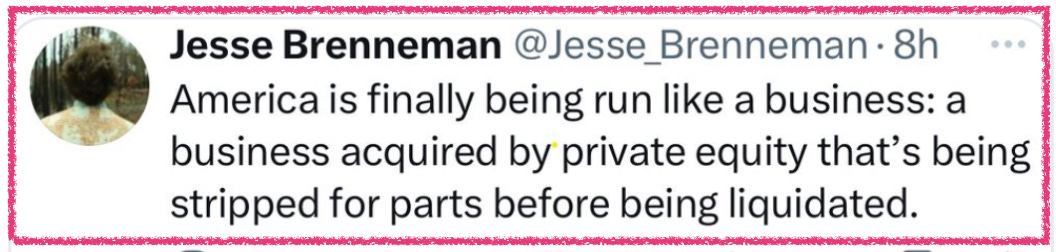
Anyone in America who works somewhere has probably been “acquired” by “a firm” of some sort for their “portfolio”; and as a result, we all of us feel this chapter of American democracy, as was, all too keenly: the Musk acquisition of America. I’ve read that the Republican voters who work in civil service never thought that the people they supported for office—that is, the venture capitalists and hedge fund managers and private equity firms—would actually strip the government and its Constitution and sell it for parts, and fire them, but they voted for Donald “You’re Fired” Trump despite all the evidence and have found out why he’s been bankrupt six times and still standing. Musk had swooped in and destroyed Twitter and it meant nothing to these voters, either. What did they think? Well, unlike Captain Renault in Casablanca, “a poor corrupt official” who knows full well how the game is played when he says, “I’m shocked, shocked to find gambling going on here” as he collects his winnings—these earnest civil servants living in their paper pushing D.C. bubble lack a social safety net moral compass. When you think life is only money, only “savings,” you may be missing, I don’t know, a heart. Or basic life experience. (And they are about to find out what unemployment looks like when there’s no money for them to claim, and no jobs to be found except the ones all those poor, now-deported undocumented people did. Godspeed.)
For anyone who needs a personal testimony of this process, the publishing house I work for was taken over, the first time, by finance people who quickly eliminated the Editorial Services Group (ESG) because they didn’t know what ESG meant. And they never asked us before handing out the pink slips and severance packages. The ESG, as it turned out, were the COPY EDITORS and FACT CHECKERS for our textbooks. Our product. Our source of revenue. And even after learning this, the financial overlords just shrugged. Who needs copy that is correct and makes sense in educational materials for America’s students? Who will really notice? $$$ (Now I do my job and their job.)
These are, after all, people who don’t believe in textbooks, obviously; we now formally live in a nation of capitalists who don’t value education because somehow they think they learned everything (and they think, everything) through osmosis.
Cue today’s lethal gem of a typical private equity business slash move:
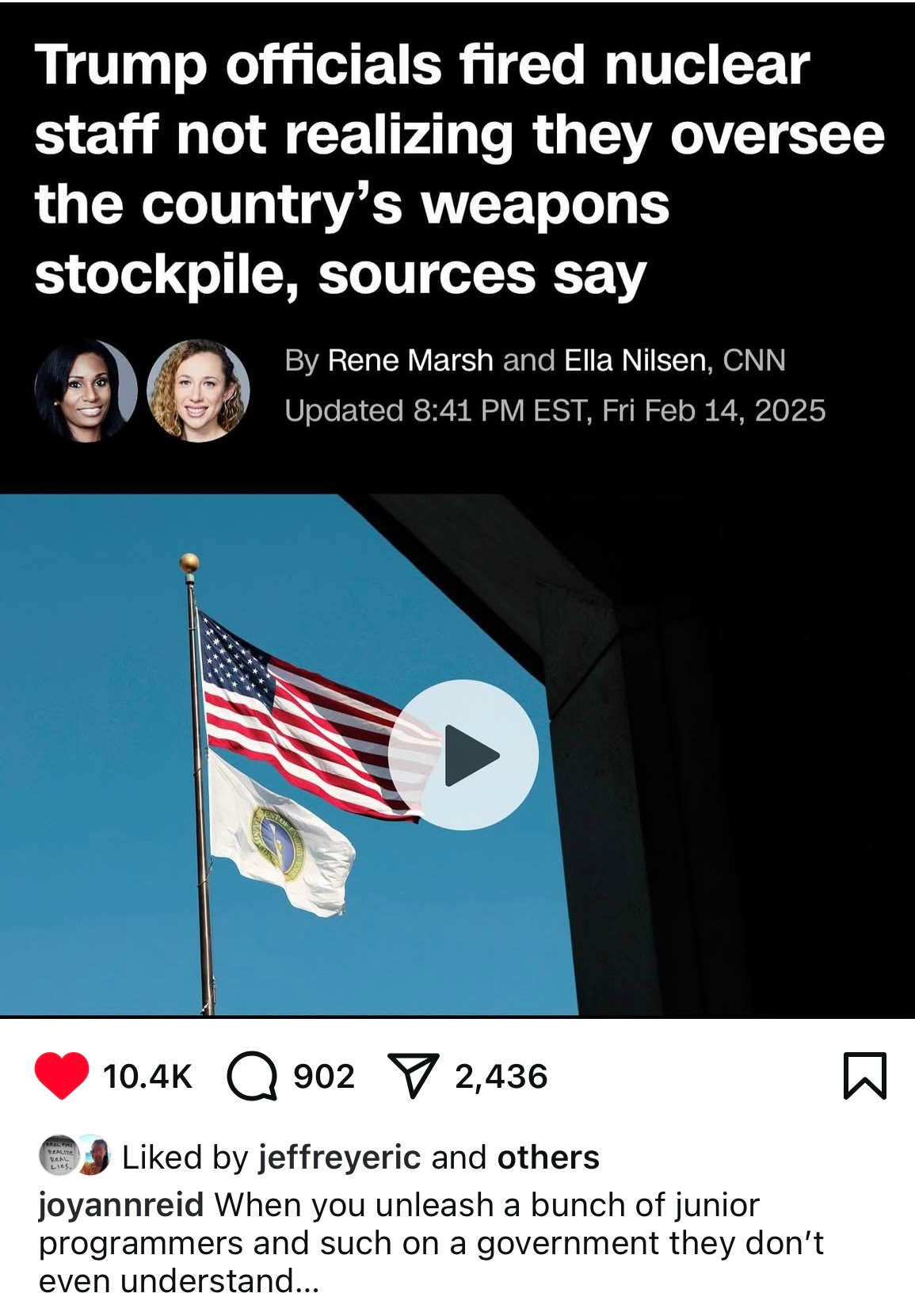
There’s not an American office worker in existence, or factory worker, or cashier, for that matter, who didn’t read that headline and nod.
Why do you need refrigerators? It’s a grocery store. No more refrigerators.
That kind of thing. Only now our entire nation’s security, health and safety, and economy are in the hands of, quite frankly, money fiends devoid of vision, purpose, or shame, let alone the “common sense” Trump claims to have. (Emerson called common sense “genius dressed in plain clothes.” Take a memo.)
In another example, I read that some 1.7 million HOMES around the country are vacant, sitting empty since being acquired by private equity firms, either for the land or the tax write-offs, with no interest in the communities in which the houses sit. Freeing these homes to be sold to people could end the housing crisis, maybe. At this rate we’ll never know. $$$?
My go-to comfort viewing during all this mess has been rewatching the 2019 documentary Toni Morrison: The Pieces I Am, directed by Timothy Greenfield-Sanders, like, a dozen times. I read a review that referred to the documentary as “flat,” and it occurs to me that it’s hard for the newer critic folks to enjoy being brought fully into a world as thoughtfully as this film brings you into a teacher and book creator’s life. The subject, Nobel Prize winning novelist Toni Morrison, is as great a subject as a literate viewer might want, unless what you want is a subject like Hemingway, who beat his four wives and fought to the death in wars and bars; or Pablo Picasso, who screwed two women on the same day and then painted them both, as a habit. I’ll take Morrison’s strong sense of self, her moral compass, unflashy living, artistry, deep humanity, and humor, thanks. And she has great literary company for additional commentary. It’s all about the love of language, and the way we use language to tell about life.
Morrison recalls a time in her early childhood where her sister was teaching her letters, and they would use pebbles to scratch the letters on the sidewalk. One day they saw a new word down the block, and they began copying, F…U…, and suddenly her mother ran out of the house and yelled at them, they were crying, they didn’t know what they’d done. In that moment, Morrison says, “I learned, words have power.” (I had a similar experience when a neighbor up the street taught tiny me and my brother Pat, “Eenie, meenie, minee, moe, catch a n***er by the toe.” Not knowing that word, I substituted one I did know, but when I used that word within earshot of my mother, it sounded bad, too, and I got yelled at. So I tried, “Eenie, meeie, minee, moe, catch a quarter by the toe.” Because I couldn’t say “nickel” anymore. My mother, realizing what she thought she’d heard, said that was fine. Even though coins don’t have toes. I learned that language can surprise you, that language is invention.)
The opening credits for the film show an artist putting together an ever-changing collage of black and white photos of Morrison’s face, pieces from the many stages of her life, along with patterned paper, to jazz music, and I could watch that over and over just by itself.

But on this day of Black History Month, I want to share this observation Morrison makes about her growing up in Lorain, Ohio, a background woven throughout the film to create a familiar texture, one that grounds the artist in a relatable experience for most of us. “It was a melting pot, it really was,” Morrison says of the Blacks, Italians, Poles, and other working-class migrants who came to this steel town along Lake Erie, where “there was no shame in being poor.” Having enough to get by, pay the bills, have a roof, meals, your people—you know, you were good. (I grew up that way, to start. My parents were working class and moved to the middle class, and it was a big deal; values started changing, more materialism, fitting in, all that. Poverty stood out. As a nation of billionaire worshipers, we need to think on that.)
But more interesting to me this time is when she says that she had come to realize that the melting pot, “the cauldron”—and here she makes the pot with the hands—“is Black people. We are the pot.”
The United States of America would not exist at all without the slave labor of Black people, and we know that; and more than that, there would not be a culture without Black people, or at least not a culture I’d want to live in. Along with our Indigenous roots, Black music, dance, energy, love, drive, gospel, wisdom, persistence; Black love, righteousness, and willingness to throw their bodies at justice, at life, to boycott the bus lines of Montgomery, Alabama, for thirteen months—all this holds the rest of the (white) country together, makes this a democratic nation, and one I can stand to live in, if not be always proud to live in. Morrison’s late life understanding that Black people were the holders of what was melting in that pot, that they were the pot, hit me hard when I watched the documentary again last night. They were our models for the fights for justice.
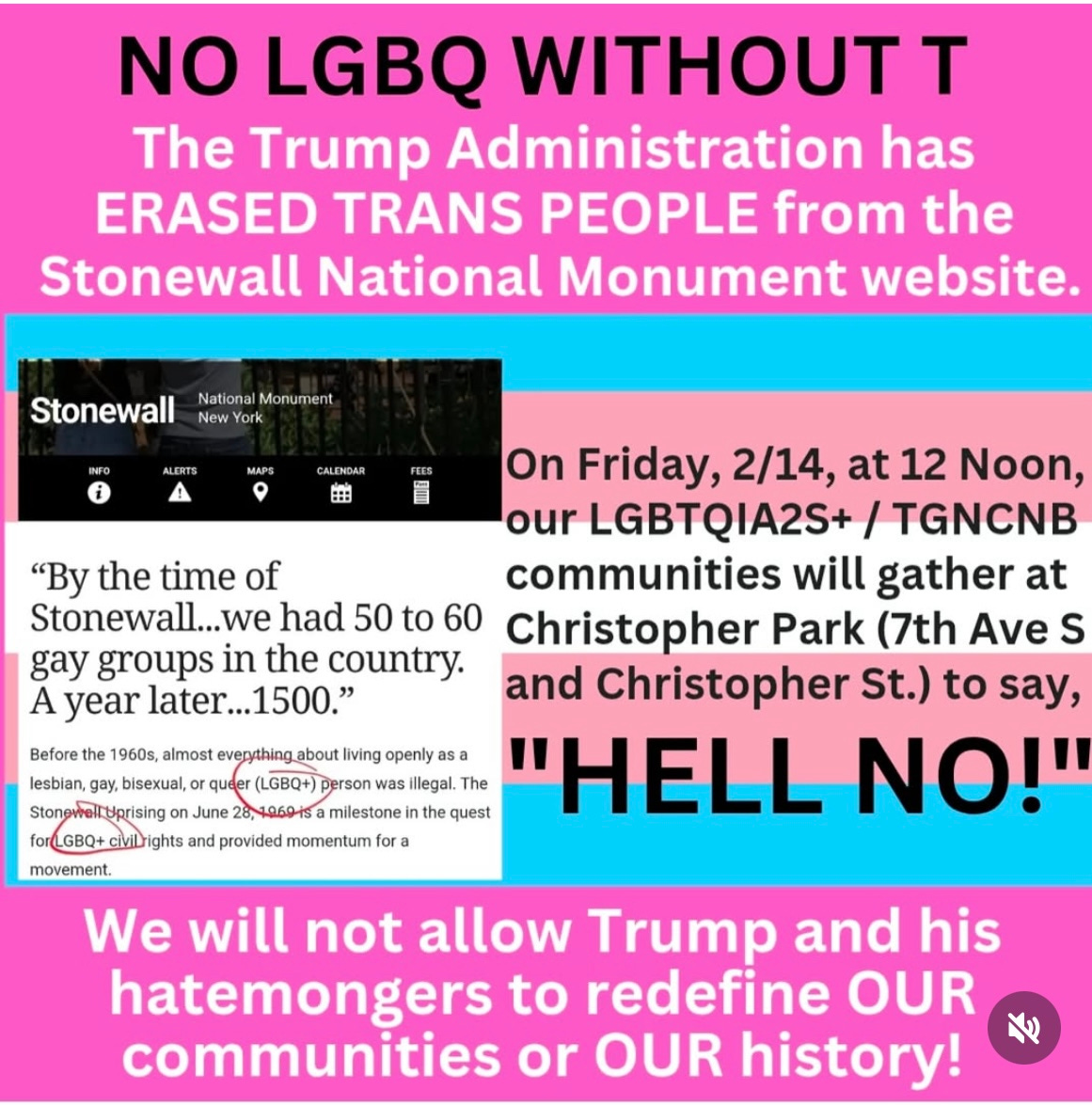
On Friday, which I’d taken off to have a four-day mini break, I’d planned to spend the cold winter day at the Met Museum but instead took a detour to the Trans Rights Rally at the Stonewall National Monument at Christopher Street. I want to be an ally. Standing with all these people, where it all began, is a little surreal. “Let’s go get coffee,” one person said to a partner part way through, checking his phone. Stonewall made that possible—to just live your life.
And really, face it, without gay men, there is no Hollywood, no theater, no fashion, no clubs, no fun. Without lesbians there is no feminism, no suffrage. These are small examples, broad strokes, but you see what I mean.
American rock music—our greatest export—has its roots in American Indigenous music as well as African music. It’s not that there are no contributions by white artists, it’s just that this country would be unrecognizable, and without doubt way less interesting or dynamic, if left only to cisgender, straight whites. (Lawrence Welk, anyone? At least there’d be no Kid Rock, what with rap off his radar.) Watch what Trump does to the Kennedy Center, if you can. You know it’s cringe.
The ironic wit and hijinks of The Onion and improv theater notwithstanding, white culture has lately been elbowing out any good stuff in order to put that glaring spotlight on capitalism, our god; private equity, individualism, willful ignorance, winner take all, white supremacy, oh, and fuck you, parasite, should there be a fuck left to give. If you see what I mean. And porn. And rape. And brews for bros.
Time to melt that into the pot. And keep it melted.
Meanwhile, keep the faith, show up, find the joy somehow. That’s what I think today. I’m trying to listen to more music. Dance. And you might watch The Pieces I Am, especially if you feel like all this fragmentation of America is making you fall to pieces. It’s so hopeful. And read Beloved.
Love,
Miss O’

 The Miss O' Show (Teacher's Edition)